Docket #: S23-344
3D printed biodegradable and biocompatible zinc implants for osteonecrosis of the femoral head
Stanford researchers have developed a 3D-printed biodegradable zinc implant with mechanical properties suitable for structural support after core decompression in osteonecrosis patients.
Osteonecrosis of the femoral head is a debilitating disease characterized by collapse of the femoral head due to an interruption in blood supply to mesenchymal and hematopoietic cells. Early diagnosis allows preservation of most of the femoral head through a procedure called core decompression. In this procedure, a path is drilled into the bone to stimulate new bone formation and blood vessels ingrowth. An implant is then inserted into the drill hole to provide structural support and guide tissue ingrowth. To date, these implants have been porous scaffolds made of nondegradable metals. Biodegradable metals can allow for more complete bone growth as the implant gradually degrades.
Stanford researchers have found that an implant made of zinc or zinc alloy in a customized 3D form can bear the load after core compression while promoting osteogenesis. They used laser powder bed fusion to 3D-print the metal into the desired geometry (Figure 1). Their prototypes featured cylindrical shapes with lattice structures, but the design can be adjusted to create any specific degradation profile for enhanced vascularization.
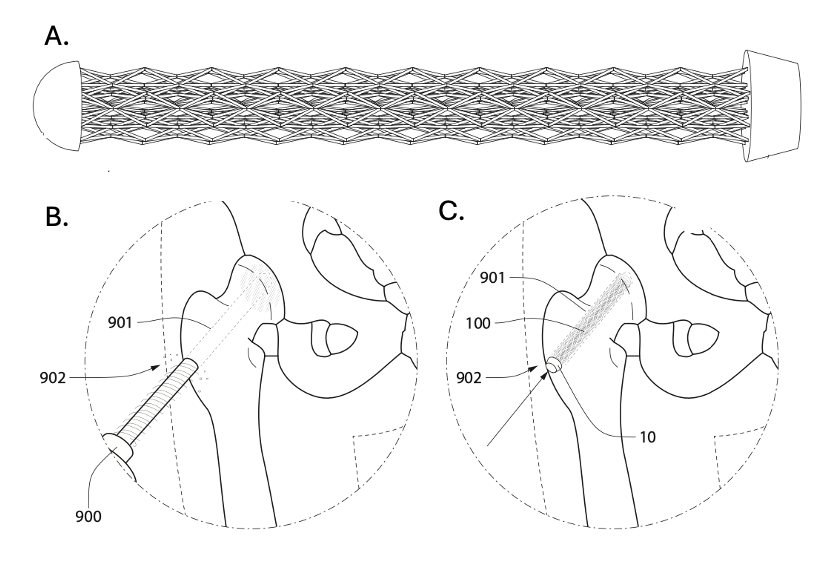
Figure 1. A) A design of the zinc implant. B) Insertion of current nondegradable implant after core depression. C) Insertion of A after core depression.
Stage of Development
Prototype
Applications
- Core decompression surgery for osteonecrosis
- Femoral head
- Humeral head
Advantages
- Biodegradable
- Better osseointegration due to enhanced osteogenesis and angiogenesis
- Load bearing capacity of nonbiodegradable metal implants
- Degradation properties can be tuned
Publications
- Li, Y., Pavanram, P., Zhou, J., et al. (2020). Additively manufactured biodegradable porous zinc. Acta biomaterialia, 101, 609–623.
Related Links
Patents
- Published Application: WO2025212755
Similar Technologies
-
An Extrudable Biomaterial with Heat-Resistant Bioactivity and Tunable Degradation S23-458An Extrudable Biomaterial with Heat-Resistant Bioactivity and Tunable Degradation
-
HyTEC: Hybrid Tissue Engineering Construct S20-447HyTEC: Hybrid Tissue Engineering Construct
-
Orthopedic Surgical Instrumentation for Joint Replacement S25-569Orthopedic Surgical Instrumentation for Joint Replacement