Docket #: S16-300
Bacterial genes for biosynthetic production of modified cellulose for biofuels, novel materials or antibiotic development
Cellulose is the most abundant biopolymer on Earth and researchers in Prof. Lynette Cegelski's laboratory have discovered a chemically modified form of cellulose, phosphoethanolamine (pEtN) cellulose, produced in bacterial biofilms. They have identified the genetic and molecular basis for the installation of the pEtN modification and developed methods to biosynthetically produce, purify and use this material and its derivatives. Cellulose materials have a wide variety of uses ranging from biomedical applications, e.g. in wound healing and bioadhesives; composite materials production; biofuels; renewable building materials; chromatography; and more. Previously, the basic cellulose structure has been modified through chemical synthesis. With this technology, the inventors unlock the potential to produce chemically modified celluloses biosynthetically by identifying the gene that enables E. coli to make pEtN cellulose, which also can be evolved and engineered to produce alternately modified celluloses. pEtN cellulose, which forms a critical component of bacterial biofilm architecture, is water soluble and a hydrogel on its own in solution, unlike unmodified or crystalline cellulose, and may hold value in applications such as those ascribed to hyaluronic acid. It could exhibit chemical and mechanical properties with unique advantages over collagen or other fibrous materials and over standard cellulose products. The amine can be readily functionalized further to produce new products, including those of use in therapeutic applications. Enzymatic modifications are possible. Other organisms, such as miscanthus, algae or other bacteria, could be bioengineered to produce soluble modified cellulose in large volumes and could lower the cost of converting the material into glucose for cellulosic ethanol production. Thus, this discovery could be used for broader synthetic biology applications by producing novel cellulose-based materials or biofuels.
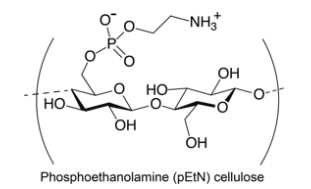
Chemical structure showing a possible arrangement of glucose and phosphoethanolamine (pEtN) glucose in pEtN cellulose.
Stage of Research
The inventors discovered pEtN cellulose in E. coli biofilm architecture, identified the bcsG gene as the genetic and molecular basis for production and validated its role in other bacterial species. The inventors are planning continued collaborations to introduce the gene into plants.
Applications
- Synthetic biology - with end-user applications such as:
- materials -- bioengineering and synthetic production of modified cellulose (pEtN and derivatives) with potential applications including chromatography paper, medical dressings, renewable building materials and carbon fiber
- biological -- applications as a newly identified hydrogel and also as a molecular adhesive
- pEtN cellulose derivatives -- therapeutic compounds can be introduced through chemistry and biochemistry approaches utilizing the amine functionality and can include various linkers; can be used for biomedical applications, such as drug presentation and can include release strategies
- biofuels -- bioengineering of switchgrass, miscanthus, algae or other bacterial species (e.g., Acetobacter xylinum) for improved production/purification of cellulosic ethanol
- Anti-infectives development -- compounds or biologicals (proteins/antibodies) that target pEtN cellulose or the enzymes that produce it could disrupt biofilms and be used against E. coli or other Gram-negative bacteria
Advantages
- Biosynthetic modification presents a unique structure produced in nature with unique properties; it is chemically and biochemically tunable; and avoids use of chemical synthesis for changes to cellulose structure
- Enhanced conversion to glucose - pEtN cellulose is soluble which could lower costs of cellulosic ethanol production due to more facile conversion to glucose
- Biofilm disruption - for antibiotic development, this novel target for biofilm architecture could enable new classes of treatment for otherwise resistant bacterial infections
Publications
- Thongsomboon, W., Serra, D. O., Possling, A., Hadjineophytou, C., Hengge, R., & Cegelski, L. (2018). Phosphoethanolamine cellulose: A naturally produced chemically modified cellulose. Science, 359(6373), 334-338.
- Stanford-led team discovers new cellulose that could have applications from energy to medicine Stanford Report January 19, 2018.
- Production and use of phosphoethanolamine cellulose and derivatives (PCT Application Publication No. WO/2018/035411)
- McCrate, O. A., Zhou, X., Reichhardt, C., & Cegelski, L. (2013). Sum of the parts: composition and architecture of the bacterial extracellular matrix. Journal of molecular biology, 425(22), 4286-4294.
- Hollenbeck EC, Antonoplis A, Chai C, Thongsomboon W, Fuller G & Cegelski L. Phosphoethanolamine Cellulose Enhances Curli-Mediated Adhesion of Uropathogenic Escherichia coli to Bladder Epithelial Cells. PNAS (2018) 115, 10106-10111.
Related Links
Patents
- Published Application: WO2018035411
- Published Application: 20190177756
- Published Application: 20210261926
- Issued: 11,667,898 (USA)
Similar Technologies
-
Drug-imprinted hydrogel for controlled-release wound healing therapy with FAK inhibitors S14-447Drug-imprinted hydrogel for controlled-release wound healing therapy with FAK inhibitors
-
Injectable Supramolecular Hydrogels for Bioprinting, Wound Healing, and Drug Delivery S20-136Injectable Supramolecular Hydrogels for Bioprinting, Wound Healing, and Drug Delivery
-
Injectable and Stable Hydrogels with Dynamic Properties Modulated by Biocompatible Catalysts S16-344Injectable and Stable Hydrogels with Dynamic Properties Modulated by Biocompatible Catalysts