Docket #: S24-122
Direct method for estimating the fraction of T and B/plasma cell-derived DNA
Researchers at Stanford University have developed a software that applies correction algorithms on sequence data from cell-free DNA (cfDNA) in blood samples to estimate total T and B cell counts.
As immunotherapy has gained traction in recent years, methods for assessing immune status have become important for disease monitoring and biomarker discovery. Among these, quantifying the total amount of T and B/plasma cells provides fundamental information. While circulating T and B/plasma cells can be easily sampled from peripheral blood, those residing in tissues require invasive sampling or advanced imaging techniques.
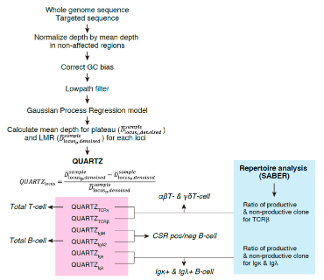
As an alternative approach, Stanford researchers developed a software called QUARTZ (QUAntification of Rearranged Targeted Zone) to estimate whole-body turnover of T and B/plasma cells using blood samples. QUARTZ analyzes sequence data of cfDNA in blood plasma that is typically disregarded due to high noise in sequencing depth. It uses selectors to target maximal rearrangement regions within immune receptor loci and derives sequencing depths at these regions. Then, the depths are corrected using GC bias correction and Gaussian process regression (GPR), enabling accurate estimation of lymphocyte subset fractions. Additionally, QUARTZ includes non-T and B cell control data derived from healthy individuals as reference, supporting comprehensive assessment of immune status.
Figure
Stage of Development
Prototype
Applications
- Predicting efficacy of immune therapies or vaccine responses
- Monitoring immune status in infectious diseases, autoimmune diseases, myeloma, PTCL, or in response to vaccination
- Characterizing T/B cell malignancies
Advantages
- Non-invasive
- Enables frequent monitoring
- Accurate and direct measurement of total amount of T-cells and B-cells
- T-cell fraction and B-cell fraction measured separately
Related Links
Patents
- Published Application: WO2026161805
Similar Technologies
-
Transcriptional engineering of TR1 cell therapies S22-475Transcriptional engineering of TR1 cell therapies
-
Programmed Death Ligand-1 was Effective in Preserving Heart Function in a Myocardial Ischemia Model S23-123Programmed Death Ligand-1 was Effective in Preserving Heart Function in a Myocardial Ischemia Model
-
A Method to Regulate Protein Function in Living Cells Using Small Molecules S06-024A Method to Regulate Protein Function in Living Cells Using Small Molecules