Docket #: S11-430
Enabling algorithms and RF circuitry for full duplex communication over arbitrary spectrum fragments
The wireless spectrum is increasingly fragmented due to the growing proliferation of unlicensed wireless devices and piecemeal licensed spectrum allocations. Current radios are ill-equipped to exploit such fragmented spectrum since they expect large contiguous chunks of spectrum to operate on. Stanford researchers have addressed this limitation by designing a new system architecture which provides radios with a general full duplex signal shaping capability, allowing them to exploit the fragmented spectrum. The system has two novel components: a programmable filter engine and a self- interference cancellation technique that enables a radio to simultaneously send and receive over different spectrum fragments. This single cancellation system can cancel the transmitted signal no matter what frequency ranges it is operating on. Thus, a single cancellation system could replace several discrete filtering components and allow for more flexible operations.
Figures
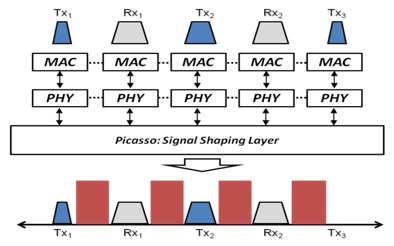
Figure 1 Architecture: This invention exposes a signal shaping API to the PHY/MAC
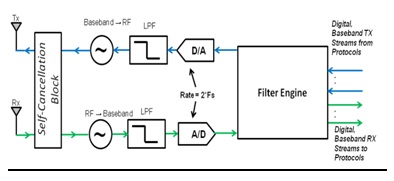
Figure 2 Block Diagram
Stage of Research:
Designed and implemented this system on a Virtex- 6 FPGA based software radio and show via empirical evaluation that it provides seamless signal shaping over fragmented spectrum without any loss of throughput to the higher layers.
On-going Research:
Continuing to evaluate methods to implement this design with a single antenna as well as extend it to MIMO.
Applications
- Access Point Networks
- Shape signal to avoid interference
- Mitigate latency for multiple clients
- Licensed Cellular Networks
- Replace discrete filtering components
- Enables global roaming
- Phones will work across operators
- WiFi Direct Networks
- Connect to multiple peers independently
- Simplifies MAC Protocol Design
- Radio Sharing
- Multiple protocols (Bluetooth, WiFi, etc.) could share the same RF front end and antenna
Advantages
- Improves upon current technology – cancels the self-interference instead of filtering it to prevent receiver saturation.
- Efficient - allows single spectrum fragments to be used for either transmit or receive, depending on the user's specification.
- Cost effective - a single cancellation system can cancel the transmitted signal no matter what frequency ranges it is operating on. Thus, a single cancellation system could replace several discrete filtering components.
- Allows for more flexible operation
- New method of signal shaping - enables radios to cleanly separate the concern of utilizing fragmented spectrum from the design of higher PHY/MAC layers.
Publications
- Steven Hong, Jeffrey Mehlman and Sachin Katti Picasso: Full Duplex Signal Shaping to Exploit Fragmented Spectrum HotNets '11 Proceedings of the 10th ACM Workshop on Hot Topics in Networks. New York, NY
Patents
- Published Application: 20130215805
- Published Application: 20160234005
- Issued: 9,325,432 (USA)
Similar Technologies
-
Multiple Tap Feed Forward Cancellation S12-176Multiple Tap Feed Forward Cancellation
-
Full Duplex MIMO Radios S13-276Full Duplex MIMO Radios
-
WiDeo: A Motion Tracing Camera using WiFi Signals S14-059WiDeo: A Motion Tracing Camera using WiFi Signals