Docket #: S26-374
First Structure of the Picornaviral 2C:RNA Holoenzyme for Broad-Spectrum Antiviral Drug Design
From the Lab of Doctor Yousuf Khan, who previously worked at AlphaFold and was one of the key members who introduced nucleic acids into the model, comes the first structure of the picornaviral 2C:RNA holoenzyme complex, together with the purification know-how, active protein samples, and strain specific models needed to design and screen broad-spectrum antiviral drugs.
Picornaviruses cause at least 8 billion infections a year, producing illnesses that range from upper respiratory failure to paralysis, yet few antiviral therapies are approved for non-polio picornaviruses. The 2C protein is the most conserved nonstructural protein in the family and an active and attractive broad-spectrum target, but inhibitor programs have relied on crystal structures of a single protomer, which lack the information of the oligomer bound to RNA in the active complex.
Using cryo-electron microscopy, the researchers resolved 2C as a hexameric ring bound to single-stranded RNA in its central pore, the first observed structure of any AAA+ protein bound to its RNA substrate. The structure defines how 2C binds RNA and distinguishes it from DNA, and the investigators showed that mutating the key residues inhibits viral replication in foot-and-mouth disease virus and coxsackievirus B3 systems. These residues are broadly conserved across picornaviruses and in related RNA virus families, including the norovirus NS3 ortholog, supporting inhibitor design that spans multiple pathogens.
Available assets include the atomic coordinates and cryoEM map ahead of significantly ahead of public release, the purification and complex assembly know-how, active protein and expression constructs including a validated mutant panel, the unpublished full length 2C complex, and homology models of the complex for specific rhinovirus and enterovirus strains.
Figure
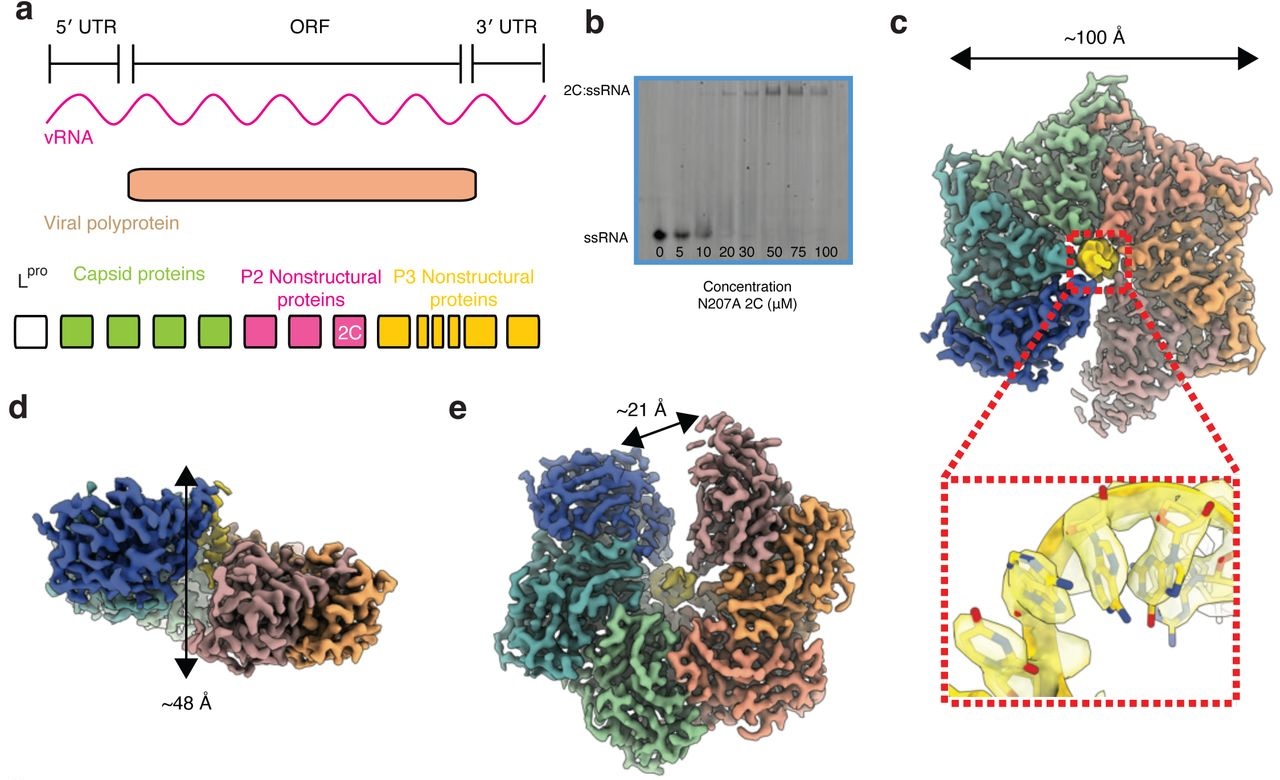
Figure Description: Architecture of the 2C:RNA holoenzyme complex: a. Schematic of the viral RNA to the final cleaved viral products, including 2C, for FMDV. b. EMSA of ?33 2C N207A with ssRNA at varying concentrations of protein. c. Top view of 2C cryoEM map colored by protomer with inlet of density (yellow) surrounding ssRNA substrate. d. Side-view of split ring of 2C. e. Bottom view of 2C cryoEM map with split ring (image credit: the inventors).
Stage of Development:
Pre-clinical. In vitro cryoEM structure at 3.05 Å, with RNA-binding and viral replication assays in two systems.
Applications
- Structure-based design of broad-spectrum antivirals against picornaviruses
- Virtual screening and drug docking against the active 2C complex
- Active protein samples for compound binding and hit-validation assays
- Purification know-how for producing 2C and orthologs from related viruses
Advantages
- First structure of 2C captured bound to its RNA substrate
- Resolves the active hexamer, not the single protomer prior programs relied on
- 3.05 Å map, with RNA locally resolved between 2.5 and 3.0 Å
- Binding residues conserved across 497 structural hits spanning nine virus families
- Supports pan-picornavirus inhibitors rather than single-virus agents
- Not reproducible computationally; Leading structure prediction tools fail to recover the complex, as the training databases contain almost no comparable protein:RNA structures
Publications
- Pfuetzner, R. A., Pinpin, L. N., Duboeuf, M., White, K. I., Tubb, A. G., Singal, B., Fernandez-Martinez, D., Arnold, W. R., Brunger, A. T., Mckenzie, G., Sweeney, T., & Khan, Y. A. (2026). The Structure of the Picornaviral 2C:RNA holoenzyme: Molecular Basis of RNA binding and specificity by a AAA+ protein. bioRxiv preprint (posted 2026-06-10; not yet peer reviewed).
Related Links
Similar Technologies
-
Prediction of RNA structure with equivariant neural networks S21-193Prediction of RNA structure with equivariant neural networks
-
Engineered Nanobodies to Protect against Viral and Microbial Contamination in Closed and Semi-enclosed Spaces S20-190Engineered Nanobodies to Protect against Viral and Microbial Contamination in Closed and Semi-enclosed Spaces
-
Enhanced vaccine efficacy using mRNA-LNP adjuvants S25-089Enhanced vaccine efficacy using mRNA-LNP adjuvants