Docket #: S13-277
Full Duplex Wireless Radios
Engineers in Prof. Sachin Katti's laboratory have developed a full duplex wireless system designed to double throughput by simultaneously transmitting and receiving signal on a standard single inband antenna. The technology combines tools from RF circuit design, digital signal processing algorithms and communications to cancel self-interference from the antenna (110 dB over 80 Mhz wide band). This is achieved with no additional hardware beyond the RF cancellation circuit. This full duplex radio could help build faster, more efficient wireless networks with specific applications in APs and base stations.
Stage of Research
Prototype – the inventors built analog circuit boards and integrated them with a fully WiFi-PHY compatible software radio implementation and demonstrated robust performance in noisy indoor environments with close to expected doubling of throughput.
MIMO implementation – described in Stanford Docket S13-276
Applications
- Wireless communications:
- point-to-point links
- multi-channel single AP WiFi
- programmable LTE phones and base stations
- LTE access
Advantages
- Increased spectrum - full duplex operation on single antenna:
- WiFi with gains near 2x from standard single antenna system
- co-existence of full duplex WiFi AP with half duplex client provides 1.5x gains
- Standard equipment:
- uses WiFi 802.11 ac PHYs
- only additional hardware is RF cancellation circuit
Publications
- US Patent Application 20140348018
- Dinesh Bharadia, Emily Mcmilin and Sachin Katti, "Full Duplex Radios", ACM SIGCOMM 2013
Full Duplex Transceiver Design
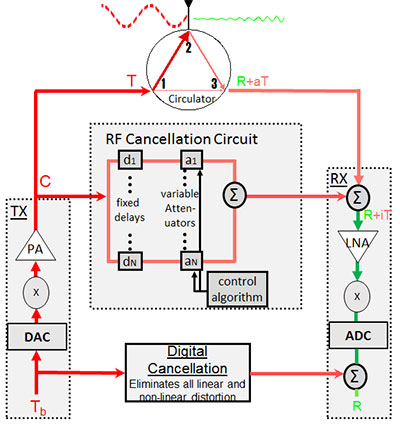
Tb is intended baseband signal we think we are transmitting, but in fact the transmit signal is T (red). The intended receive signal is R (green), however we see strong components of the red signal the RX side. Some of these red signals are undesirably leaked through the circulator. The analog cancellation circuit is trying to recreate a signal that matches the leaked interference signal for cancellation. The digital cancellation stage eliminates any residual self interference.
Related Links
Patents
- Published Application: 20140348018
- Issued: 10,284,356 (USA)
Similar Technologies
-
Full Duplex MIMO Radios S13-276Full Duplex MIMO Radios
-
A System for Remote Parametric Detection, Localization, and Identification of Passive Tags using Radio Frequency and Ultrasound Waves S19-154A System for Remote Parametric Detection, Localization, and Identification of Passive Tags using Radio Frequency and Ultrasound Waves
-
A method for short range wireless data communication using wireless powering S14-087A method for short range wireless data communication using wireless powering