Docket #: S22-090
Harnessing Cathelicidin Gene CAMP Upregulation as Adjuvant Therapy for Disease Treatment and Prevention
Researchers at Stanford University have found that upregulating cathelicidin gene expression can improve the efficacy of a wide variety of treatments as an adjunct therapy. By leveraging NK cell activation and cytokine regulation (IL-2/IL-15), the method lowers pharmaceutical effective dose and cytotoxicity, reduces side effects, and enhances immune response against tumors and pathogens. This universal immune enhancer can be used alongside a variety of cancer treatments, including NK cell therapy, treatments of viral, bacterial or fungal infections, and the treatment and prevention of Alzheimer's and diabetes.
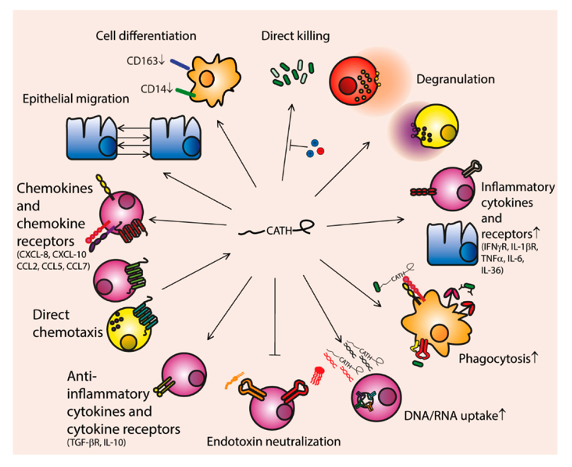
Various Functions of Cathelicidin
(Image courtesy the Barron Lab)
Stage of Development - Proof of Concept
Applications
- Adjuvant therapy for:
- Infectious disease treatments, including vaccines, antimicrobial, antifungal, and antiviral compositions
- Cancer treatments, including NK cell therapy
- Alzheimer's and diabetes treatments and prevention
Advantages
- Enhances treatment efficacy: is antimicrobial, strengthens host defense mechanisms, reduces systemic inflammation, and speeds wound healing by enhancing stem cell migration
- Can address treatment resistance through immune system enhancement to potentially help patients whose diseases have stopped responding to conventional treatments
- Versatile:
- Applicable across a broad range of diseases
- Applicable across a broad range of treatments from simple lifestyle interventions to sophisticated pharmaceutical combinations
- Can be added to existing treatment protocols
- Multiple pathways for immune enhancement
- Can be administered alone or as adjuvants
- May reduce pharmaceutical cytotoxicity, allow primary treatment optimization, and lower the effective dose required
- May have fewer side effects as natural compounds are generally well-tolerated
- Cost effective, accessable, and personalizable
Related Links
Patents
- Published Application: 20230355671
Similar Technologies
-
Treating Cognitive Impairment from Cancer Immunotherapy by Chemokine Receptor Inhibition S25-003Treating Cognitive Impairment from Cancer Immunotherapy by Chemokine Receptor Inhibition
-
Methods to Prevent T-cell Exhaustion and Improve CAR-T Cell Immunotherapy with Small Molecules S17-119BMethods to Prevent T-cell Exhaustion and Improve CAR-T Cell Immunotherapy with Small Molecules
-
Genetically Encoded STING Agonists for Programmable Immune Activation in Cell Therapies S25-407Genetically Encoded STING Agonists for Programmable Immune Activation in Cell Therapies