Docket #: S24-266
Metal Waterwater Jet Nozzle for Laser-generated MeV Ion Beams
Stanford researchers have developed a metal water jet nozzle that enables laser-generated MeV ion beams. When paired with a laser system, the technology could enable more compact, cost-effective medical isotope production and other ion-beam applications. Medical isotope production often relies on nuclear reactors or large accelerator facilities, which can be expensive, infrastructure-intensive, and geographically limited. Stanford researchers have developed a metal water jet nozzle that produces a thin, stable water sheet for generating high-energy ion beams with high-power laser pulses. In prototype demonstrations, the system produced >10 MeV proton beams and achieved high ion beam dose deposition in materials. This approach could enable smaller and potentially safer laser-based facilities for medical isotope production, ion beam research, accelerator technologies, and future therapeutic applications.
Stage of Development:Prototype We have demonstrated continuous, stable operation for up to 10 hours at a time under vacuum and 3.3Hz laser bursts at three petawatt laser facilities including ELI Beamlines in Prague, ALEPH in Colorado, and the TAU in Tel Aviv. The next steps are continued development of different thicknesses and dimensions of liquid sheets to accommodate different applications, which are only a question of changing the shim geometry and can be done without significant R&D.
Figure 1:
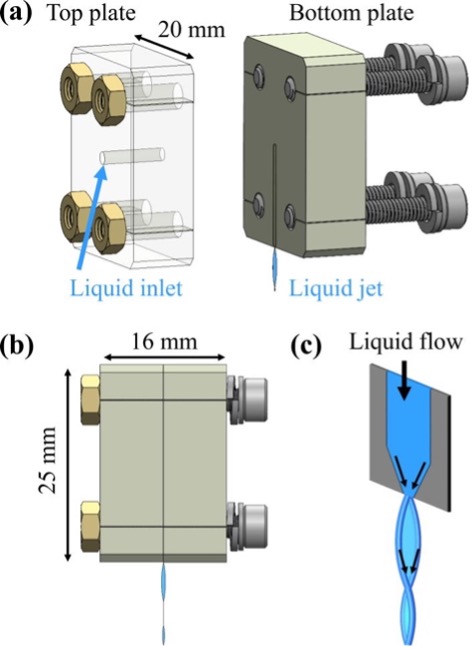
This figure shows the tungsten nozzle geometry taken from Treffert et al., https://doi.org/10.1063/5.0097857t
Figure 2:
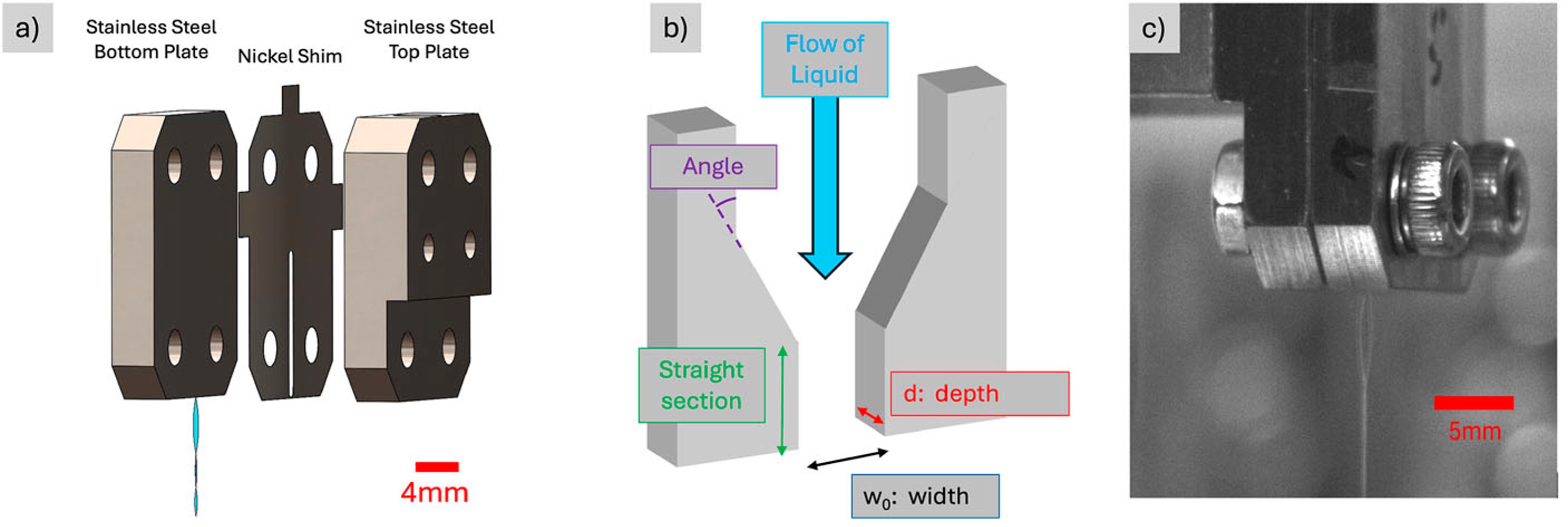
Stainless steel nozzle drawing with water sheet from Faubel et al RSI 2025, https://doi.org/10.1063/5.0283523
Figure 3:
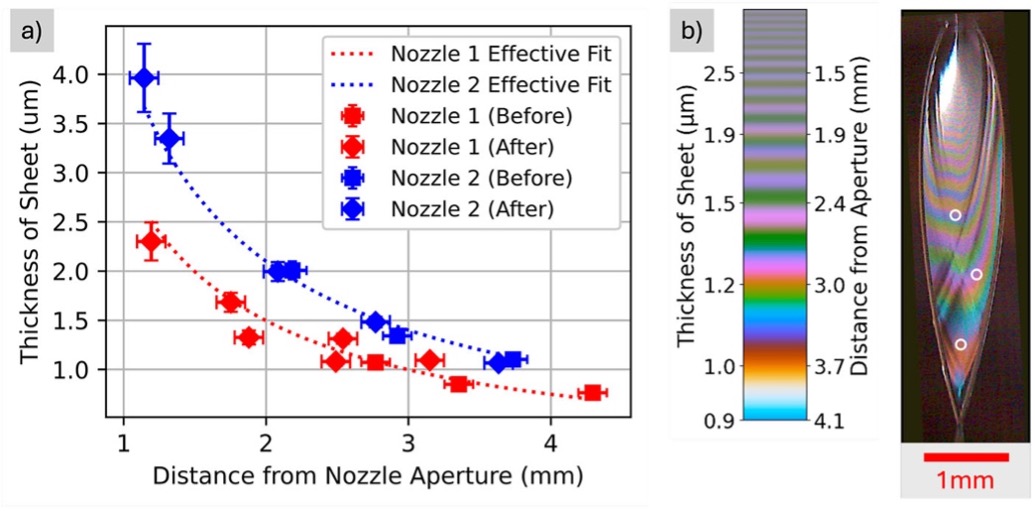
The ultra-thin sheet thickness variation across the length of the liquid sheet demonstrates the ability to reach micron to sub-micron thicknesses which is advantageous to achieve high proton energies.
Applications:
High-flux proton beams generated from water-sheet targets can be used to produce diagnostic and therapeutic radioisotopes currently produced using accelerators, including short-lived PET tracers whose usefulness is currently constrained by transport time from centralized production sites. A compact, hospital-sited source addresses that constraint directly, and the water target's low cost and continuous operation make routine clinical-scale production economically realistic. Beyond isotope synthesis, the platform functions as a proton beam source in its own right, delivering short, intense pulses with a naturally broad spectrum that can be filtered or shaped to the requirements of a given application — a capability of growing interest to radiobiology programs investigating ultra-high-dose-rate delivery, where conventional accelerators struggle to reach the necessary instantaneous dose rates.
The technology is equally relevant across accelerator development and ion beam research. A laser-driven ion source can be a testbed for developing hybrid accelerator architectures in which a laser-driven front end feeds a conventional accelerating stage. Since conventional accelerators typically operate at repetition rates of kilohertz or higher, the use of a high repetition rate liquid target for the laser-driven ion source is a key enabling advance for hybrid accelerator architectures. For fundamental ion beam research, the water sheet provides a reproducible, self-renewing target that supports the long, statistically robust data campaigns that solid-foil targets make impractical. The same proton beams can additionally serve to investigate radiation damage effects on materials where aerospace, defense, and semiconductor programs require accessible ion sources to qualify components against single-event effects and cumulative displacement damage. In addition, in conjunction with a secondary target, a neutron source can be developed.
Advantages:
Laser-driven ion acceleration sustains accelerating fields orders of magnitude stronger than those achievable in conventional radiofrequency structures, allowing ion energies that typically require conventional accelerators tens of meters long to be reached in millimeter-scale distances. The practical consequence is a dramatic reduction in facility scale: a table-top laser system and its target chamber occupy a single room, in contrast to the dedicated buildings, extensive beamline infrastructure, and heavy shielding vaults required by cyclotrons or other conventional accelerators. This makes it feasible to site isotope production within individual hospitals rather than at a small number of centralized facilities. Point-of-use production removes the transport losses that limit the availability of short-lived isotopes, lowers per-dose cost, and eliminates the vulnerability of a distribution network in which a single facility outage can disrupt supply nationwide. The water-sheet target is what makes such a system practical to operate. A continuously flowing sheet is regenerated between shots at negligible consumable cost and produces essentially no debris — protecting focusing optics and diagnostics that would otherwise degrade rapidly after repeated solid-target interactions. This supports sustained operation at the kilohertz repetition rates of modern high-power laser systems.
Laser-driven ion acceleration sustains accelerating fields orders of magnitude stronger than those achievable in conventional radiofrequency structures, allowing ion energies that typically require conventional accelerators tens of meters long to be reached in millimeter-scale distances. The practical consequence is a dramatic reduction in facility scale: a table-top laser system and its target chamber occupy a single room, in contrast to the dedicated buildings, extensive beamline infrastructure, and heavy shielding vaults required by cyclotrons or other conventional accelerators. This makes it feasible to site isotope production within individual hospitals rather than at a small number of centralized facilities. Point-of-use production removes the transport losses that limit the availability of short-lived isotopes, lowers per-dose cost, and eliminates the vulnerability of a distribution network in which a single facility outage can disrupt supply nationwide. The water-sheet target is what makes such a system practical to operate. A continuously flowing sheet is regenerated between shots at negligible consumable cost, preventing the need for repeated replacements of targets that require time-consuming vacuum chamber cycling. Furthermore, the lack of debris from solid-protects costly focusing optics and diagnostics that would otherwise degrade rapidly after repeated solid-target interactions. This supports sustained operation at the kilohertz repetition rates of modern high-power laser systems.
Different to other liquid sheet target platforms, our nozzle embeds the converging channel geometry used to generate a liquid sheet from a water source securely within its metal encasing through our shim-plate design. This enables increased usability, where the nozzles can be installed and handled without concerns for damage or alignment. Additionally, this allows for unpreceded increased stability, where the metal encasing enables damage tolerance to tens of kilojoules of laser energy without compromising performance.
Publications
- M. J. V. Streeter et al.; Stable Laser-Acceleration of High-Flux Proton Beams with Plasma Collimation. Nat. Commun 2025, 16.
- S. Faubel, G. D. Glenn, G. Jain, M. Gauthier, S. H. Glenzer; Replenishing liquid sheet targets to enable high-intensity high-repetition-rate laser–plasma interactions for ion-beam technology. Rev. Sci. Instrum. 1 September 2025; 96 (9): 093304.
- G. D. Glenn et al.; Characterization and automated optimization of laser-driven proton beams from converging liquid sheet jet targets. Phys. Rev. Research. 8, 013101. 2026.
- F. Treffert, G. D. Glenn, H.-G. J. Chou, C. Crissman, C. B. Curry, D. P. DePonte, F. Fiuza, N. J. Hartley, B. Ofori-Okai, M. Roth, S. H. Glenzer, M. Gauthier; Ambient-temperature liquid jet targets for high-repetition-rate HED discovery science. Phys. Plasmas 1 December 2022; 29 (12): 123105.
- F. Treffert, C. B. Curry, H.-G. J. Chou, C. J. Crissman, D. P. DePonte, F. Fiuza, G. D. Glenn, R. C. Hollinger, R. Nedbailo, J. Park, C. Schoenwaelder, H. Song, S. Wang, J. J. Rocca, M. Roth, S. H. Glenzer, M. Gauthier; High-repetition-rate, multi-MeV deuteron acceleration from converging heavy water microjets at laser intensities of 1021 W/cm2. Appl. Phys. Lett. 15 August 2022; 121 (7): 074104.
Related Links
Similar Technologies
-
Piezoelectric Neutron Generator (SPAN) S15-084Piezoelectric Neutron Generator (SPAN)
-
Precision Dose Tracking for MR-LINAC Radiotherapy S24-447Precision Dose Tracking for MR-LINAC Radiotherapy
-
Quality Assurance (QA) Phantom for off-axis spatial accuracy for frameless single-isocenter Multitarget Stereotactic Radiosurgery S19-098Quality Assurance (QA) Phantom for off-axis spatial accuracy for frameless single-isocenter Multitarget Stereotactic Radiosurgery