Docket #: S25-056
A multi-functional solid nanoparticle system NeuProIO for glaucoma therapy: combining neuroprotection with intraocular pressure control
Stanford researchers have repurposed two existing drugs and created a combined nanoparticle formulation that provides both intraocular pressure management and neuroprotection for glaucoma therapy.
Glaucoma is the leading cause of irreversible blindness, caused by elevated intraocular pressure (IOP) that damages retinal ganglion cells and the optic nerve. Current treatment options, including medication, laser therapy, and surgery, only focus on IOP control and neglect to repair the damaged retina and optic nerve. A therapy that can both reduce IOP and provide neuroprotection would be ideal for improved patient outcomes.
Researchers in the Hu Lab at Stanford University have developed a dual-action solid drug nanoparticle (NP) eyedrop formulation, NeuProIO, that offers both neuroprotection and IOP reduction. Having previously found that the antidepressant maprotiline (MAP) has neuroprotective properties that preserve retinal ganglion cells, optic nerve, and visual function, they combined MAP with IOP reduction drug betaxolol (BX). This combination was formulated into hydrophobic solid NPs to enable higher drug loading and improved permeability across lipophilic biological barriers such as the cornea. Reconstituted in aqueous buffer as an eyedrop, the NPs can travel to the posterior eye, which has a challenge in the past. NeuProIO provides a promising approach for comprehensive glaucoma management.
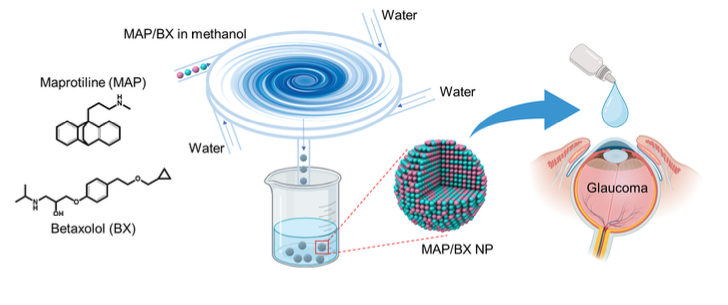
Figure 1. Schematic illustration of the fabrication of MAP/BX NPs via flash nanoprecipitation and ocular drug delivery of MAP/BX NPs.
Stage of Development
Preclinical
Applications
- Glaucoma
Advantages
- Repurposed drugs
- Sustained IOP-lowering and neuroprotection efficacy
- Scalable production
- Improved stability
- Improved ocular biocompatibility
- Improved tissue permeability
- Improved bioavailability
- Reduced dosing frequency
Publications
- Chen, W., Liu, P., Liu, D., Huang, H., Feng, X., Fang, F., Li, L., Wu, J., Liu, L., Solow-Cordero, D. E., & Hu, Y. (2022). Maprotiline restores ER homeostasis and rescues neurodegeneration via Histamine Receptor H1 inhibition in retinal ganglion cells. Nature communications, 13(1), 6796.
Related Links
Patents
- Published Application: WO2026207117
Similar Technologies
-
A suprachoroidal spacer implant to treat glaucoma S23-174A suprachoroidal spacer implant to treat glaucoma
-
Three Series of Chemical Inhibitors: Targeting ER Stress to Combat Neurodegenerative Disorders S23-411Three Series of Chemical Inhibitors: Targeting ER Stress to Combat Neurodegenerative Disorders
-
Oligocarbonate molecular transporters across biological barriers S08-441Oligocarbonate molecular transporters across biological barriers