Docket #: S26-333
A Targeted Theranostic Small Molecule for Hard-to-Treat Cancers
Researchers at Stanford have developed a novel small-molecule radiopharmaceutical designed to deliver targeted radiation directly to cancer cells while minimizing harm to surrounding healthy tissue.
Many cancers, including gliomas, lung cancer, pancreatic cancer, and melanoma, remain difficult to treat safely with existing therapies. Current radionuclide treatments typically rely on antibodies or peptides as delivery vehicles, but these approaches carry drawbacks: peptides tend to accumulate nonspecifically in organs such as the kidney and liver, while antibodies can trigger immune responses and linger in the bloodstream. Critically, neither platform readily crosses the blood-brain barrier, limiting treatment options for patients with brain tumors.
This technology uses a small molecule to home in on a protein that is selectively overexpressed across a wide range of tumor types. Once localized to the tumor, high-energy, short-range radiation is delivered precisely at the site, reducing collateral damage to adjacent healthy tissue. The compound's specificity and small size enables blood-brain barrier penetration, opening new possibilities for brain cancer treatment. For diagnostic imaging, the molecule can be radiolabeled with fluorine-18, the most widely used and clinically relevant PET radioisotope, while its therapeutic counterpart can carry bromine-77 (an Auger electron emitter) or astatine-211 (an alpha emitter). Together these form a matched theranostic pair for selecting patients, delivery treatment, and monitoring response.
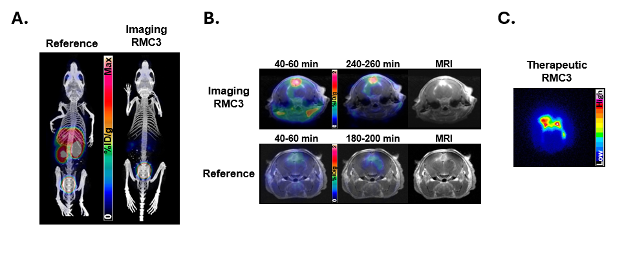
Proof of concept pre-clinical data has been obtained with the RMC3 molecule radiolabeled with either diagnostic or therapeutic radioisotopes, as compared to our first generation reference compound, (Figure 1) and further preclinical testing is currently underway.
Stage of Development: Preclinical
Figure 1
Applications
- Targeted radiotherapy drug for lung, brain, pancreatic, and other solid tumors
- Theranostics platform enabling combined cancer imaging and therapy: fluorine-18 based PET imaging paired with bromine-77 or astatine-211 targeted radiotherapy
- Platform technology expandable to additional tumor types sharing the same surface marker
Advantages
- Reaches brain tumors: crosses the blood-brain barrier, unlike antibody- or peptide-based agents
- Small-molecule format reduces nonspecific organ accumulation, immunogenicity, and prolonged blood circulation
- High-energy, short-range radiation (Auger electrons from bromine-77 or alpha particles from astatine-211) delivers potent tumor cell kill with minimal off-target toxicity
- Fluorine-18 diagnostic version uses the most widely available clinical PET radioisotope, supporting patient selection and treatment monitoring with existing PET infrastructure
- Lower manufacturing cost compared to antibody-based radionuclide alternatives
Related Links
Similar Technologies
-
Targeting Cancer Stem Cell Metabolism via Isoform-specific ALDH1B1 and ALDH1A3 Inhibitors S20-218Targeting Cancer Stem Cell Metabolism via Isoform-specific ALDH1B1 and ALDH1A3 Inhibitors
-
Treating Cardiac Dysfunction with 15-PGDH Inhibition S23-552Treating Cardiac Dysfunction with 15-PGDH Inhibition
-
Antibody-Targeted Molecular Glue Degraders for Selective Cancer Therapy S25-550Antibody-Targeted Molecular Glue Degraders for Selective Cancer Therapy