Docket #: S25-140
Tunable Microneedle Applicator for Delivery and Sampling
Stanford researchers have developed an innovative, mechanically tunable microneedle applicator that enables consistent and reliable insertion of microneedle arrays into skin for drug delivery, diagnostics, and sampling applications.
Microneedle array patches have emerged as a promising alternative to traditional injections, enabling minimally invasive delivery of vaccines and therapeutics as well as biomarker sampling through the skin. However, reliable application of microneedles remains a key challenge. Current systems often rely on manual thumb pressure or external applicators, making insertion highly dependent on user technique, applied force, and angle. This variability can lead to incomplete needle penetration, needle deformation, inconsistent dosing, and unreliable biomarker sampling. Existing applicators can also be bulky and expensive, limiting usability in decentralized or resource-limited settings.
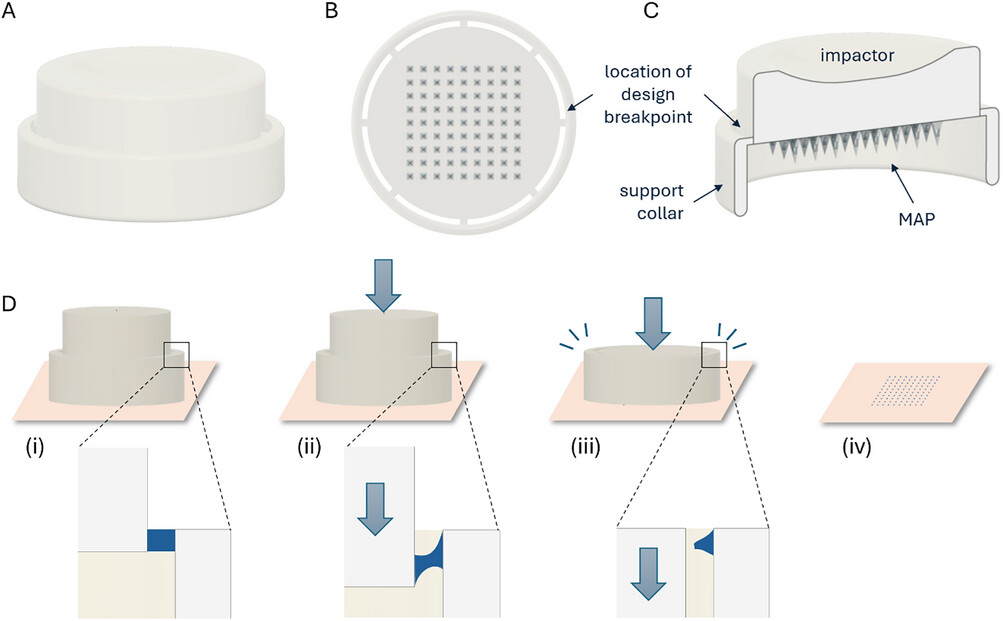
The Stanford technology addresses these challenges through a mechanically programmed insertion mechanism based on controlled breakage of engineered struts or membranes, ensuring that the patch is applied with a predefined and repeatable force independent of the user. When pressed against the skin, these structures break at precisely defined force thresholds, regulating insertion force and maintaining a consistent application angle.
The design is inherently single-use and compatible with scalable manufacturing, enabling reliable microneedle delivery across clinical, home-use, and research settings.
Stage of Development
Pre-clinical
Figure
Applications
- Self-administered vaccine and drug delivery patches
- Interstitial fluid sampling for biomarker diagnostics
- Transdermal delivery of biologics and anesthetics
Advantages
- Consistent, user-independent insertion force
- Controlled insertion angle and improved penetration
- Single-use design reduces contamination risk
- Scalable, low-cost manufacturing compatible with injection molding and 3D printing
Publications
- D.Ilyn, J. L.Hwang, I. A.Coates, et al. "Tunable Applicator for Microneedle-Based Medical Devices." Advanced Materials Technologies (2026): e02525.
Similar Technologies
-
Vacuum-integrated Microneedle Platform for Enhanced Interstitial Fluid Collection S25-215Vacuum-integrated Microneedle Platform for Enhanced Interstitial Fluid Collection
-
Triply Periodic Microneedle Array Patches (TP-MAPs) with Continuously Curved Micro-Networks for Capillary-Driven Drug Delivery and Intradermal Fluid Collection S25-574Triply Periodic Microneedle Array Patches (TP-MAPs) with Continuously Curved Micro-Networks for Capillary-Driven Drug Delivery and Intradermal Fluid Collection
-
A Mini-Patch Magnetic Insulin Pump for Enhanced Delivery Resolution and Accuracy S25-116A Mini-Patch Magnetic Insulin Pump for Enhanced Delivery Resolution and Accuracy