Docket #: S26-306
Unified AI-Augmented Administrative Governance Platform for Academic Medical Centers
Researchers at Stanford have developed a unified, AI-augmented governance platform purpose-built for the clinical, research, and educational operations of academic medical centers (AMCs).
AMC departments today run physician funds-flow reconciliation, restricted-fund compliance, faculty oversight, and shared-space allocation on manual spreadsheets and siloed shadow systems. Compliance audits typically cover only 1 to 5% of transactions, and leaders decide on reports weeks or months out of date. No existing enterprise or governance software is purpose-built for the AMC mission.
The platform is a single web application with five integrated modules for funds-flow auditing, restricted-fund compliance, faculty productivity, shared-space utilization, and executive oversight. Each module uses a large language model with domain-specific instructions and a constrained output structure to extract and classify raw institutional data, then applies deterministic logic to produce ranked findings with rule citations and remediation guidance. A natural-language assistant grounded in the loaded data supports scenario modeling and cross-module queries. Initial validation on synthetic institutional data covered ~95%+ of transactions and produced auditable findings across all five domains, with a reported ~40% reduction in administrative burden.
Figure
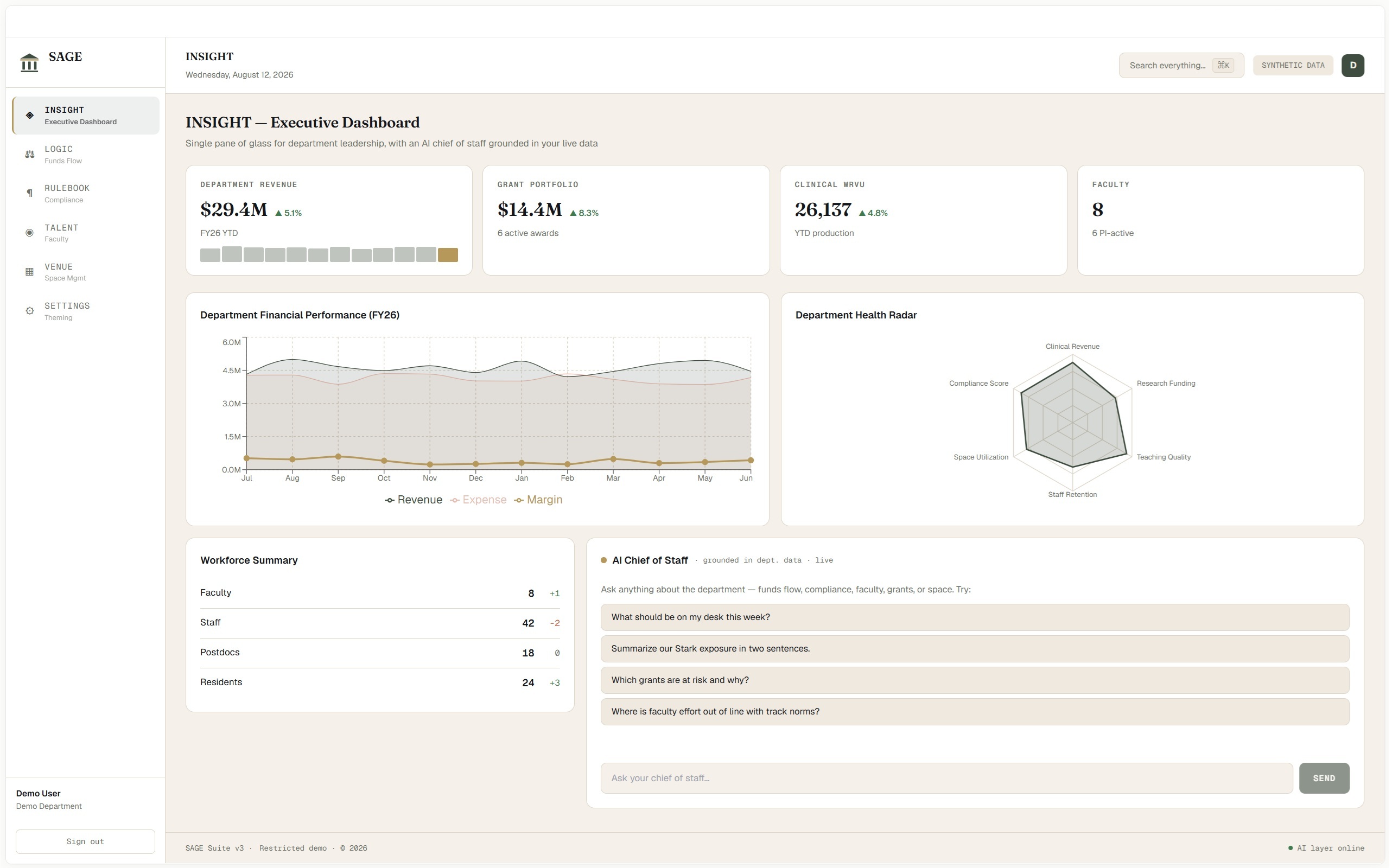
INSIGHT — Executive Command module: unified single-pane-of-glass view across LOGIC, RULEBOOK, TALENT, and VENUE with an AI Chief-of-Staff assistant grounded in loaded department data.
Stage of Development:
Functional prototype. All five modules code-complete as a unified web application, validated on synthetic institutional data.
Applications
- Unified administrative governance SaaS for academic medical center departments
- Physician funds-flow and Stark Law audit software for hospital compliance offices
- Restricted-fund compliance monitoring for research administration and finance offices
- Faculty portfolio and protected-time management for academic health center leaders
Advantages
- Consolidates five governance functions currently handled by separate systems
- ~95%+ transaction coverage versus 1 to 5% audit sampling today
- AI reasoning paired with deterministic math: no model-generated numeric errors
- Model-agnostic: institutions plug in their own secure AI endpoint
- ~40% reported reduction in administrative burden in early testing
Related Links
Similar Technologies
-
Assessing Cardiac Function from Ultrasound Videos Using Deep Learning Algorithms S20-050Assessing Cardiac Function from Ultrasound Videos Using Deep Learning Algorithms
-
Collaborative Health Outcomes Information Registry (CHOIR) Software Sourcecode S13-390Collaborative Health Outcomes Information Registry (CHOIR) Software Sourcecode
-
A Secure Machine Learning Model to Standardize Radiology Reports S24-488A Secure Machine Learning Model to Standardize Radiology Reports