Docket #: S18-465
Algorithmic framework for enhanced artificial sight
Stanford researchers at the Chichilnisky lab have patented an artificial retina framework for dynamic electrical stimulation to improve the performance of electronic visual implants. The prototype surpasses existing approaches by using a closed-loop device with so-called "greedy dictionary-based encoding", for precise electrical stimulation of retinal ganglion cells (RGCs) in a way that is algorithmically designed specifically to maximize visual performance. This critical step addresses the vision restoration challenge of accurately targeting multiple RGC types to overcome vision loss.
Researchers developed a simple visual perception model and created calibrated RGC activity dictionaries through electrical stimulation combined with recording. Using these personalized dictionaries to process incoming visual signals, they achieved near-perfect efficiency through a greedy algorithm that optimized electrical stimulation patterns dynamically over time to achieve the most acute visual perception. The dynamic stimulation is similar to temporal dithering in CRT monitors, where simple patterns are interleaved in quickly time to produce a complex pattern. The algorithmic framework produces less heat, and decreases lag time of visual communication.
This approach could dramatically improve the performance of implants for sight restoration, and has broader applications for high fidelity neural implants in ophthalmology, neurology, and audiology.
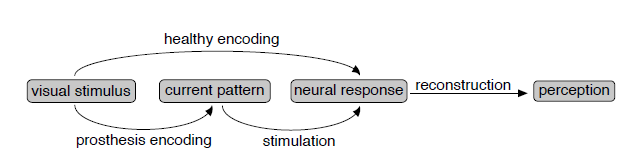
Visual Encoding Steps in a Healthy Retina and with a Retinal Prosthesis
(Image courtesy the Chichilnisky Lab)
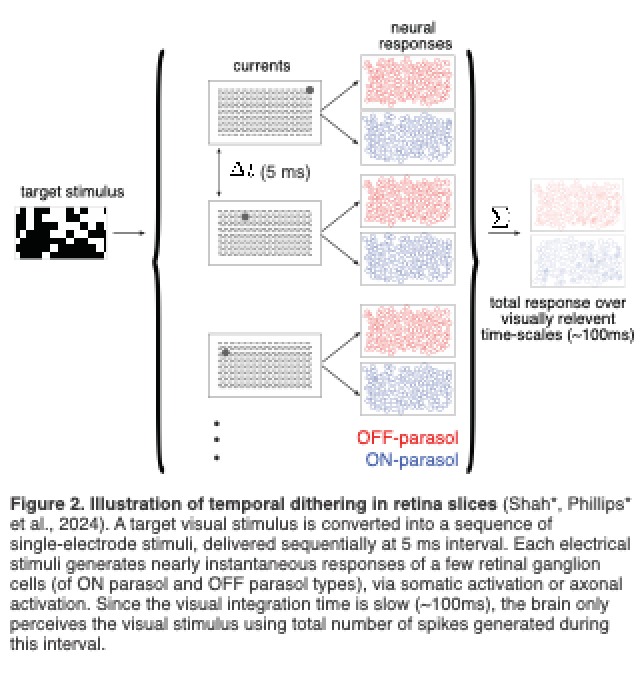
Illustration of Temporal Dithering in Retina Slice
(Image from Shah*, Phillips*, et al., 2024)
Stage of Development - Prototype:
Proof of concept prototype was tested via a primate retina and dense electrode array. Work is ongoing to improve image quality, refine algorithms and dictionaries of multi-electrode stimulation patterns, and delve further into the retinal signals of the brain.
Applications
- Vision restoration for individuals with blinding retinal diseases such as retinitis pigmentosa, diabetic retinopathy, and macular degeneration.
- High-fidelity neural implants for applications in ophthalmology, neurology, and audiology.
Advantages
- Near optimal single electrode stimulation with more precise stimulation patterns - 96% efficiency
- Adaptation to eye movement like a normal eye pattern
- Higher resolution visual perception
- More natural visual experience for users - Less lag time with visual processing from inside to outside of the eye and faster sequential stimulation
- Safer, more efficient with less heat generated – no damage to structures inside the eye
- Near optimal single electrode stimulation with more precise stimulation patterns – 96% efficiency
- Adaptation to eye movements that are part of natural vision
- Higher resolution visual perception by optimal selection of electrical stimuli
- More natural visual experience for users
- Less lag time with visual processing from inside to outside of the eye and faster sequential stimulation
- Safer, more efficient with less heat generated
Publications
- Shah, Phillips, Madugula, Lotlikar, Gogliettino, Hays, Grosberg, Brown, Dusi, Tandon, Hottowy, Dabrowski, Sher, Litke, Mitra & Chichilnisky, et al. Precise control of neural activity using dynamically optimized electrical stimulation. eLife (2024).
- Shah, N. P., Madugula, S., Grosberg, L., Mena, G., Tandon, P., Hottowy, P., Sher, A., Litke, A., Mitra, S., & Chichilnisky, E. J. (2019, March). Optimization of electrical stimulation for a high-fidelity artificial retina. In 2019 9th International IEEE/EMBS Conference on Neural Engineering (NER) (pp. 714-718). IEEE.
- Shah, N. P., & Chichilnisky, E. J. (2024). U.S. Patent No. 12,151,103. Washington, DC: U.S. Patent and Trademark Office.
Related Links
Patents
- Published Application: WO2020191408
- Published Application: 20220168571
- Issued: 12,151,103 (USA)
Similar Technologies
-
Artificial Retina Interface for Vision Restoration S25-310Artificial Retina Interface for Vision Restoration
-
Ultrasonic neuromodulation with Pattern Interference Radiation Force (PIRF) S16-382Ultrasonic neuromodulation with Pattern Interference Radiation Force (PIRF)
-
The Stanford/NASA Vision Chip S02-139The Stanford/NASA Vision Chip