Docket #: S25-310
Artificial Retina Interface for Vision Restoration
Stanford Artificial Retina Project researchers have developed an ASIC Retina Chip that interfaces with retinal ganglion cells to restore vision in patients with retinal degeneration.
The Retina Chip with an array of high surface area electrodes:
• Conforms to the retina's curved surface, customizable to each patient's eye shape
• Records and stimulates retinal ganglion cell activity with bidirectional signal transfer
• Achieves 40× data compression while preserving signal fidelity (less than 5% cell loss)
• Higher electrode density provides improved visual resolution
• Lower power consumption support long-term implantation
This artificial retina breakthrough provides a promising treatment for conditions like retinitis pigmentosa and age-related macular degeneration, where photoreceptors fail but ganglion cells remain viable.
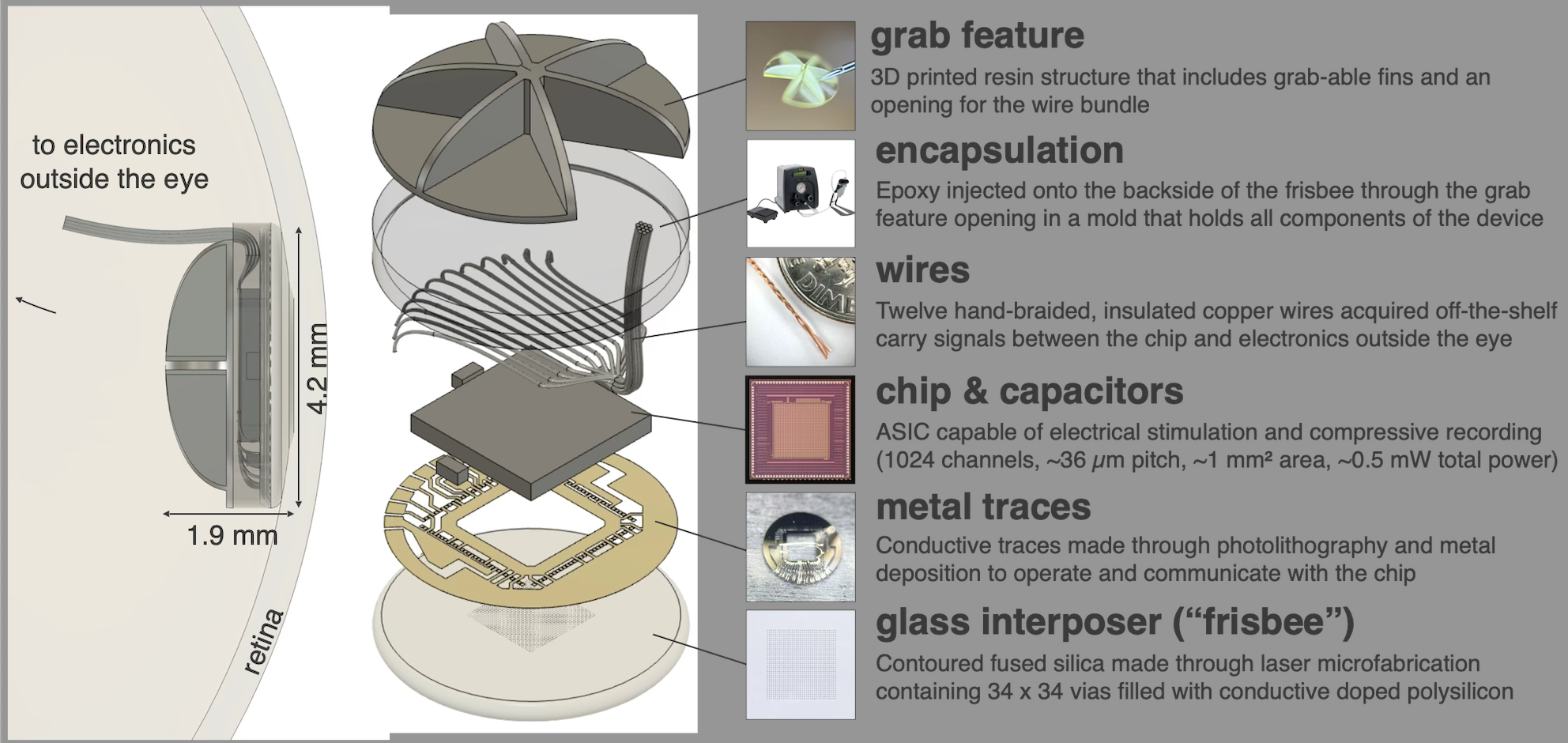
Stanford Artificial Retina Project Retina Chip Principal Components
(Image courtesy the Stanford Artificial Retina Project)
Stage of Development – Proof of Concept Prototype
First in vivo tests are planned for 2025 with human tests within a few years.
Applications
- Treatment for blindness due to retinal degeneration
Advantages
- High channel density for higher-resolution artificial vision
- Reproduces natural electrical signals and preserves action potential fidelity - essential information about which cells are firing and when for better vision restoration
- Minimizes data transmission requirements for wireless operation
- Customized fit tailored to the eye shape of the patient
Related Links
Similar Technologies
-
Algorithmic framework for enhanced artificial sight S18-465Algorithmic framework for enhanced artificial sight
-
Smart Calibration Software for High-Precision Neural Implants S23-120Smart Calibration Software for High-Precision Neural Implants
-
Ultrasound for Detecting and Suppressing Epileptic Seizure S18-336Ultrasound for Detecting and Suppressing Epileptic Seizure