Docket #: S17-112
Architecture for scalable, large bandwidth, low loss millimeter wave (MMW) antenna arrays
Researchers in the Arbabian Lab at Stanford have developed a scalable antenna architecture that uses low-loss dielectric waveguides to achieve passive, phase-coherent signal distribution across large (>30 wavelengths) millimeter-wave (mm-wave) arrays for communications and radar applications.
Conventional interconnects for mm-wave arrays suffer from high transmission loss and limited bandwidth. This patented invention solves those problems by distributing signals directly at mm-wave frequencies through dielectric waveguides for very efficient signal distribution over large baselines, with no local frequency conversion hardware required. This technology can greatly increase capacity of short range (chip-to-chip or board-to-board) to medium range (rack-to-rack) wireless communications links and improve resolution in imaging and radar systems.
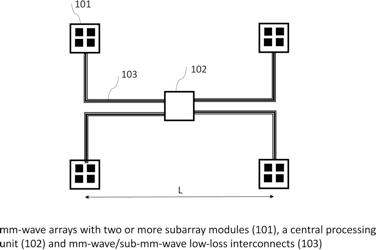
Figure 1 – Diagram of passive, phase-coherent mm-wave signal distribution via dielectric waveguides
(Image courtesy the Arbabian Lab)
Stage of Development: Prototype
Loss and bandwidth performance demonstrated experimentally.
Applications
- RF antenna arrays
- Radar (phased array antennas) and high-resolution imaging systems
- 5G, backhaul, and last-mile wireless communications networks (beam-forming antennas)
- Automotive radar and sensing, drone and mobile platform communications
- High-speed data center interconnects
Advantages
- Large aperture: >30 wavelengths
- Very low signal loss and wide bandwidth compared to conventional metallic mm-wave waveguides
- Passive phase coherence across large array baselines, no active stabilization required
- Eliminates local frequency up/down conversion, reducing subarray hardware complexity
- Strong immunity to electrical interference
- Scalable across the 20 to 500 GHz frequency range
- Improves imaging resolution and wireless link capacity compared to conventional architectures
- CMOS-compatible fabrication
Publications
- Dolatsha, N., Arbabian, M. A., & Mamandipoor, B. (2021). U.S. Patent No. 11,101,828. Washington, DC: U.S. Patent and Trademark Office.
Related Links
Patents
- Published Application: WO2018195453
- Published Application: 20210135691
- Issued: 11,101,828 (USA)
Similar Technologies
-
Multiple Tap Feed Forward Cancellation S12-176Multiple Tap Feed Forward Cancellation
-
Low-Power, Active Light Tuning via MEMS Optical Antenna S17-095Low-Power, Active Light Tuning via MEMS Optical Antenna
-
Enabling algorithms and RF circuitry for full duplex communication over arbitrary spectrum fragments S11-430Enabling algorithms and RF circuitry for full duplex communication over arbitrary spectrum fragments