Docket #: S25-185
Enabling New Diagnoses: Stanford's Tool Brings Hospital-Grade ECGs to Remote Monitoring
Stanford researchers have developed a new software platform that transforms clinical ambulatory cardiac monitoring. This innovative tool reconstructs standard 12-lead ECGs from the recordings of commercial devices that use far fewer leads, and it does so without any hardware modifications. This advancement enables continuous ambulatory monitoring for disease states that are currently unmonitored or poorly managed outside of hospital settings.
While a standard 12-lead ECG is essential for capturing crucial diagnostic information like accurate QT intervals, arrhythmia localization, and signs of ischemia, these devices are typically confined to hospitals. In contrast, widely available commercial devices such as insertable cardiac monitors, implanted devices, and ECG patches offer far fewer leads and provide a much narrower view of cardiac activity. This invention eliminates that compromise by offering a software solution that generates a full 12-lead ECG from the limited data provided by these ambulatory devices. This technology enables new commercial products and services, including advanced ECG analysis platforms, remote patient monitoring for specific conditions, and AI-enhanced diagnostic platforms for a wide range of customers, from device manufacturers and clinicians to pharmaceutical companies.
Figure:
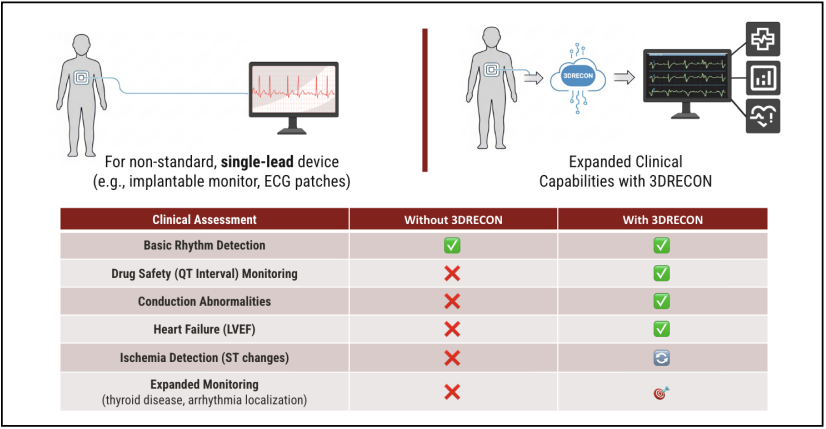
Image Credit: Inventor
Stage of Development: Others; Clinical data validation
Applications
- Advanced ambulatory ECG Analysis - integrated software addons for implantable and wearable cardiac devices capable of detecting QT prolongation, ischemic changes, arrhythmia localization, conduction abnormalities, heart failure status, and electrolyte disturbances, along with other disease states under development.
- Continuous QT monitoring solutions - dedicated software solutions for patients undergoing QT prolonging drug, allowing for ambulatory QT interval surveillance.
- Provides clinicians with a standard 12-lead ECG from an ambulatory device recording of a nonstandard, narrowly-spaced electrode pair.
- AI-enhanced ECG diagnostics through reconstruction - enabling ambulatory use of deep learning ECG models that previously required hospital based 12-lead ECGs
Advantages
- No hardware modification required
- Compatible with current cloud-based AI infrastructure
Publications
- Ansari, Rayan A., et al. Deep Learning–Based Continuous QT Monitoring to Identify High-Risk Prolongation Events After Class III Antiarrhythmic Initiation. AHA/ASA Journals: Circulation (2025).
Related Links
Similar Technologies
-
Robust, on-line, real time system and method for neuron spike recovery S18-232Robust, on-line, real time system and method for neuron spike recovery
-
Ultrathin Flexible Multilead Electrocardiogram Bandage for Arrythmia Diagnosis and Monitoring S19-061Ultrathin Flexible Multilead Electrocardiogram Bandage for Arrythmia Diagnosis and Monitoring
-
A wirelessly powered, fully internal implant that enables optogenetic stimulation of brain, spinal cord, and peripheral nervous system in untethered mice S14-453A wirelessly powered, fully internal implant that enables optogenetic stimulation of brain, spinal cord, and peripheral nervous system in untethered mice