Docket #: S14-037
Fabricating Complex Electronic Passive Components with 3D Printing
Researchers in Dr. Juan Rivas-Davila's lab have developed 3D printing methods to make aircore inductors and capacitors with more complex geometries and functionality than components using printed circuit boards. Currently, power converters are manufactured using expensive and heavy magnetic materials or printed circuit boards (PCBs). However, the two dimensional nature of PCBs limits the complexity of geometries that can be manufactured. By using 3D printing, complex passive components can be manufactured with lower cost, lower weight, a wide variety of geometries, and added electrical and thermal functionality such as cooling.
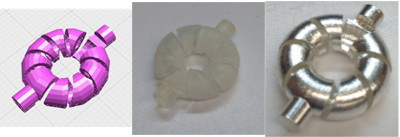
(left) 3d CAD model (center) 3D printed plastic mold (right) cast silver inductor
Stage of research
As proof of concept the inventors designed and implemented a 13.56 MHz 25 W class ?2 inverter with 3D printed inductors.
Applications
- High efficiency, high performance power supplies for:
- Communication
- Radar
- Plasma generation
- Lasers
- X-ray
- Lighting
- Computers
- Power converters for:
- Computers
- Hybrid and electric vehicles
Advantages
- Flexible process that enables more complex and varied designs
- Round edges
- Cross sections
- Overhanging structures
- Easy to manufacture
- Enhanced functionality - Components can be designed to enhance device cooling
- Eliminates need for tuning
Publications
- This technology has been presented at the 2014 IEEE Energy Conversion Congress & Exposition. Pittsburgh, PA, 9/2014.
Related Links
Patents
- Published Application: WO2016036854
- Published Application: 20170287633
- Issued: 11,031,179 (USA)
Similar Technologies
-
Multiple Tap Feed Forward Cancellation S12-176Multiple Tap Feed Forward Cancellation
-
Using frequency modulation for ultra-fast RF power control S25-020Using frequency modulation for ultra-fast RF power control
-
High Q Inductor S04-112High Q Inductor