Docket #: S18-480
Flexible X-ray Gratings for X-ray differential phase contrast (DPC) imaging systems
Stanford researchers at the Hasselink Lab have developed a method for making a high aspect ratio phase grating structures on a substrate that can be curved to better meet the optics requirements in X-ray differential phase contrast (DPC) imaging systems.
DPC is different from traditional X-ray imaging since it provides three different outputs (attenuation, phase contrast, dark-field) instead of one, and can improve detection of unknown materials with improved image contrast. Traditionally, high aspect ratio gratings are made with X-ray lithography and LIGA process, which requires synchrotron radiation X-ray sources. In contrast, this process is more simple and fully compatible with silicon semiconductor processes, thus easier for mass manufacturing with lower costs.
The team tested its prototype with X-ray DPC imaging and demonstrated enhanced field-of-view (FOV) and improved image qualities.
Figure
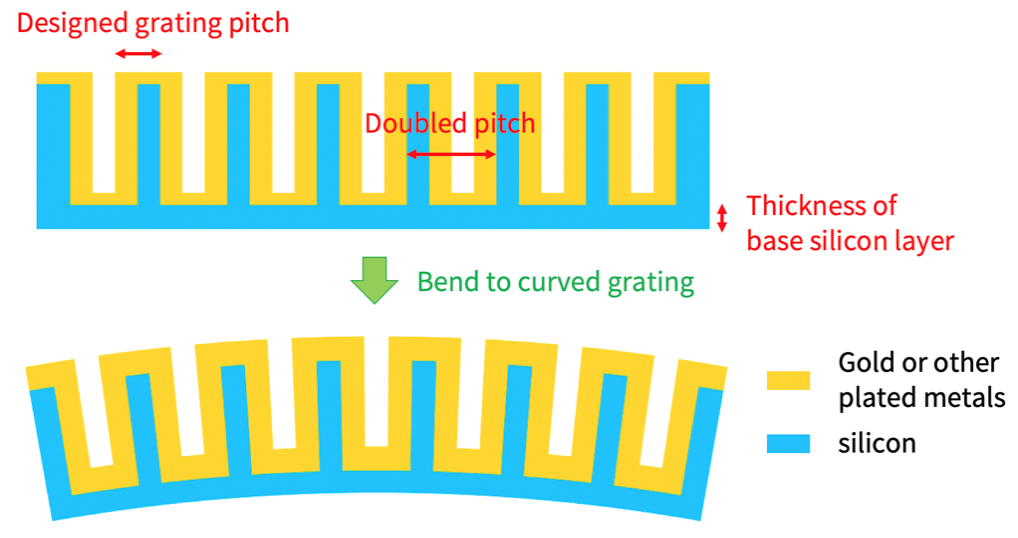
Figure description - Illustration of X-ray grating with a flexible thin base silicon layer
Stage of Research
Applications
- X-ray baggage scanning
- Homeland Security
- X-ray differential phase contrast (DPC) imaging system or other X-ray interferometers that require X-ray grating
Advantages
- Higher field-of-view
- Improved detection of materials
- More enhanced images due to tri-signature imaging mode
- Compatible with silicon semiconductor processes, thus easier for mass manufacturing with lower costs
Related Links
Patents
- Published Application: 20200222017
- Issued: 11,116,463 (USA)
Similar Technologies
-
Enhanced photoelectron sources using electron bombardment S13-018Enhanced photoelectron sources using electron bombardment
-
Fates - Compact, Sensitive X-ray Differential Phase Contrast Imaging System S16-173Fates - Compact, Sensitive X-ray Differential Phase Contrast Imaging System
-
Photo Emitter X-Ray Source Array (PeXSA) S12-318Photo Emitter X-Ray Source Array (PeXSA)