Docket #: S21-329
Laser-Assisted Manufacturing of Microstructured Electrodes and Dielectrics for Force Sensor Applications
Stanford researchers have developed a laser-assisted digital manufacturing platform to generate soft and stretchable microstructured components for next-generation force sensors. Through a facile, cost-effective, and tunable fabrication approach, the team has developed a variety of precisely patterned electrodes and dielectrics with versatile functionalities in both standalone and multiplexed force sensing applications.
Electronic components with microstructured surfaces hold tremendous utility in high-performance force sensing, including the development of capacitive or piezoresistive pressure, shear, and vibration sensors. However, traditional photolithographic or sacrificial agent-based manufacturing techniques for micropatterning substrates are difficult, time-consuming, and expensive. Moreover, such strategies are not readily conducive to fabricating large-area distributed force sensors and suffer from limited design flexibility and sensing performance tunability. The inventors' low-cost, straightforward, and high-throughput approach leverages computer-aided design and laser-guided manufacturing to produce surface microstructures on diverse substrates ranging from glass and wood to laser-compatible plastics. The flexible implementation of laser writing parameters enables exquisitely tunable feature shapes, sizes, linewidths, and distributed patterns, potentiating the fabrication of myriad electrodes and dielectrics tailored to the desired specifications. This innovative platform facilitates the production of finely microstructured components for a multitude of discrete and multiplexed force sensing applications in robotics and medical devices.
Stage of Development
Prototype — the inventors' manufacturing approach has been successfully deployed to fabricate components for pressure, shear, and vibration sensors.
Figure
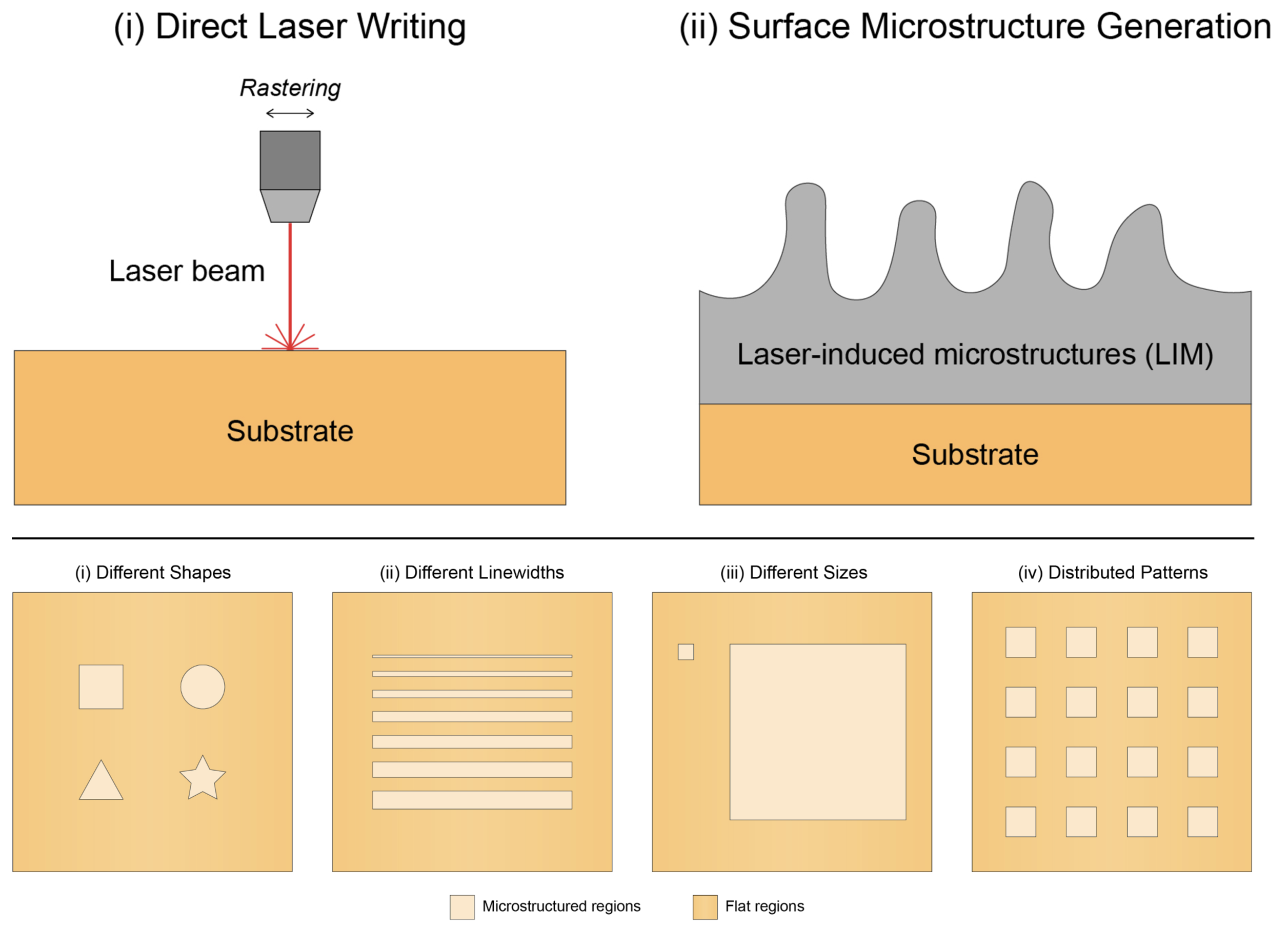
Figure Description: Top, schematic diagram of laser-assisted fabrication of surface microstructures. Bottom, feature tunability of laser-scribed microstructures.
Applications
- Dynamic tactile perception systems for robotics applications
- Force-mapping devices for medical diagnostic and therapeutic applications
- Wearable devices and sensors for physiological and physical monitoring
- Force-sensing devices for interactive human-machine interfaces
Advantages
- Streamlined, high-throughput, and cost-effective fabrication platform
- Extensive design flexibility and performance tunability for diverse sensing applications
- Compatible with the development of large-area and distributed force sensors
Related Links
Similar Technologies
-
Small, Robust, Highly-Sensitive Six-Degree of Freedom Capacitive Force/Torque Sensor S16-273Small, Robust, Highly-Sensitive Six-Degree of Freedom Capacitive Force/Torque Sensor
-
A biomimetic electronic skin (e-skin) with discriminating forces S18-419A biomimetic electronic skin (e-skin) with discriminating forces
-
Self-Powered Electronic Skin S14-211Self-Powered Electronic Skin