Docket #: S21-217
Mechanical Swimmer as Portable, Versatile Rheometer
Researchers at Stanford are advancing a new paradigm in rheological measurement. Conventional rheometers, which are used to measure the mechanical properties of fluids (biological or engineered), are large table top devices that require extensive training and a large sample volume to operate. The Stanford technology envisions a freely suspended swimming "robot" that can be placed in a fluid remotely, and via its motion creates various measures (e.g., swimming speed, rotational velocity, etc.) and reports them to a remote data collector in real time to determine local fluid properties. The scale and location of the robot determine the scale and location of the mechanical properties measured, and in principle the robot can be steered to a location of interest. The size of the robot can be varied from a few microns to meter size, and the scale of the robot also determines the scale of the volume of fluid necessary for measurement – thus in principle very small volumes of fluid in its native environment can be assessed. Once calibrated the robot is easy to use and highly portable, and the post processing of data can be done using something simple such as an application on a cell phone.
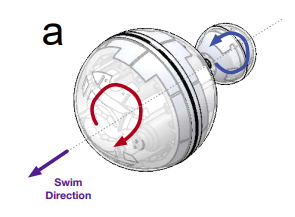
Figure (a) The design of a rotationally-symmetric swimming robot is pictured. Note that both the head and tail are spheres of different sizes (image credit: manuscript submitted to Nature Physics)
Stage of Development
The researchers have demonstrated the first proof of principal device and associated theoretical
framework to measure physical properties of complex fluids.
Applications
- Rheological measurement of a fluid remotely
- Medical, biological, industrial instrumentation
Advantages
- May reach locations difficult or currently impossible to access (e.g., medical applications)
- No harvesting of the fluid is necessary; compatible to extremely small volumes of fluids (e.g., rare biological small volume samples)
- The state of the fluid in application is the state of the measurement (temperature, pressure, etc.) without attempted reproduction of conditions
- Measurements could be made in different locations (via steering the swimmer) to examine heterogeneity of a sample
- Scale is variable (from microns to meter)
- Potentially cheaper than existing rheometers
- Potential for multiplexing and significant increase in throughput
- Could be disposed/dissolved upon completion of measurement
- Portable and versatile - collection and processing of the data can be done on a handheld device
Publications
- Binagia, J., E.S.G. Shaqfeh, "Self-propulsion of a freely suspended swimmer by a swirling tail in a viscoelastic fluid", Phys. Rev. Fluids, 6, 053301 (2021), DOI: 10.1103/PhysRevFluids.6.053301,(Editor's Selection in PRFluids for May, 2021)
Related Links
Patents
- Published Application: WO2023015033
- Published Application: 20240353302
- Issued: 12,644,812 (USA)
Similar Technologies
-
Manufacturing Method for Synthetic Gecko-Inspired Adhesives S10-333Manufacturing Method for Synthetic Gecko-Inspired Adhesives
-
Electrochromic Resistive Pressure Sensor S15-225Electrochromic Resistive Pressure Sensor
-
LINAC-Compatible Robotic Ultrasound Manipulator for Radiotherapy Guidance S12-162LINAC-Compatible Robotic Ultrasound Manipulator for Radiotherapy Guidance