Docket #: S24-420
A Non-Invasive Diagnostic Platform for Precise, Biomarker-Based Detection of Active Bacterial Infections
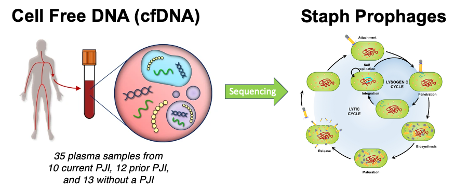
Stanford researchers have developed a novel blood-based diagnostic platform that leverages circulating bacteriophage DNA (phage cfDNA) to enable sensitive and highly specific detection of both overt and subclinical bacterial infections, while effectively discriminating them from benign colonization.
Accurate diagnosis of infections such as periprosthetic joint infection (PJI) remains a significant clinical challenge. Conventional microbiological culture is often invasive, time-consuming, and subject to false negatives, while standard bacterial DNA assays cannot reliably distinguish pathogenic organisms from the harmless commensal microbiota. This technology overcomes such limitations by profiling DNA from bacteriophages—viruses that selectively infect bacteria—that are circulating in the patient's plasma. Because bacteriophages mirror the presence and activity of their bacterial hosts, the pathogen-specific phage signatures provide a highly specific molecular correlate of true infection versus background colonization.
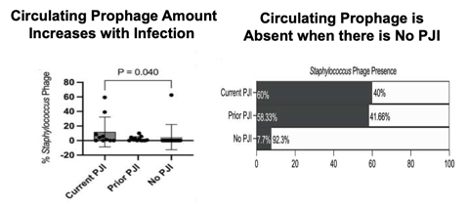
In proof-of-concept studies, detection of Staphylococcus-specific phage cfDNA in plasma achieved 92% specificity for confirmed staphylococcal infections. The inventors' platform thus offers a robust "rule-in" diagnostic approach, even in ambiguous or culture-negative cases.
Figures
Stage of Development
Pre-clinical — validation on human plasma samples
Applications
- Non-invasive diagnosis of musculoskeletal and prosthetic device-associated infections including PJI, plus detection of a broad range of other bacterial infections.
- Discrimination of pathogenic infections from benign commensal colonization.
- Adjunctive tool to culture-based diagnostics in orthopaedics, cardiology, and infectious disease spheres.
Advantages
- Minimally invasive sampling via simple venipuncture.
- High specificity for pathogen detection supports robust "rule-in" diagnosis for confident clinical decision-making and therapeutic targeting.
- Enables early detection of infections missed by standard culture methods, including subclinical infections undetectable by conventional diagnostics.
- Broad applicability across multiple bacterial pathogens and taxa, enabling development of a scalable diagnostic platform for infectious diseases.
Publications
- R. Manasherob, D. Furukawa, N.L. Haddock, T.H.W. Chang, A. Hargil, P. Arora, N. Banaei, W.J. Maloney, P.L. Bollyky, and D.F. Amanatullah (2025). Circulating Bacteriophage DNA Distinguishes Staphylococcal Infection from Commensal Colonization. Journal of Arthroplasty. Published online October 8, 2025.
Related Links
Similar Technologies
-
A microfluidic chip for automated, parallel nucleic acid testing from raw samples S25-398A microfluidic chip for automated, parallel nucleic acid testing from raw samples
-
Systems, Devices, and Methods Analyzing Exhaled Breath to Detect Indications of a Bacterial Infection S24-389Systems, Devices, and Methods Analyzing Exhaled Breath to Detect Indications of a Bacterial Infection
-
DART-Met: Dynamic AI-Driven Raman Techniques for Biomarker monitoring in Metabolic disorders S25-113DART-Met: Dynamic AI-Driven Raman Techniques for Biomarker monitoring in Metabolic disorders