Docket #: S16-402
Quantifying Speed of Sound in Tissue for Medical Ultrasound
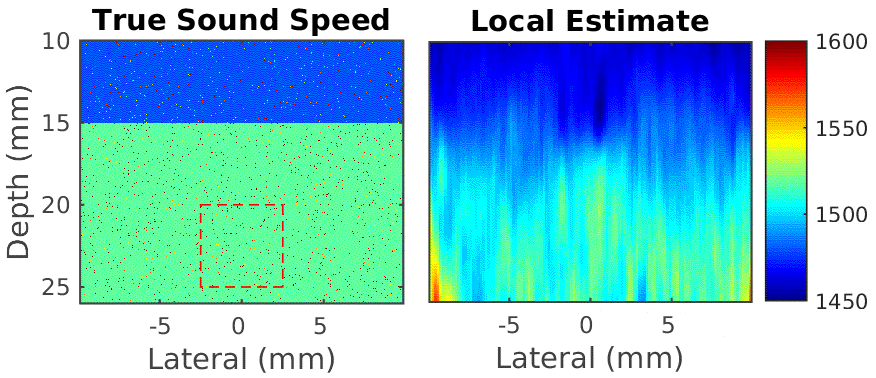
Stanford researchers developed an ultrasound method to estimate the local speed of sound of tissue, regardless of the tissue overlying the target location. The method uses existing pulse-echo transducer arrays and ultrasound hardware, and does not require any specialized equipment. It is also more accurate than existing estimators. Since the method provides a quantitative measure of speed of sound - a parameter that is often related to disease state - it may aid the diagnosing and assessing of non alcoholic fatty liver disease (NAFLD), nonalcoholic steatohepatitis (NASH), cancer, tumors, and inflammation.
Stage of Research
Researchers have demonstrated the method reduces bias and variance compared to existing speed of sound estimation methods and systems.
Applications
- Ultrasound imaging
- Quantitative assessment of nonalcoholic fatty liver disease (NAFLD) and nonalcoholic steatohepatitis (NASH)
- Quantitative assessment of cancer and non-cancerous tumors, and inflammation
Advantages
- Compatible with existing clinical ultrasound scanners (e.g. pulse-echo ultrasound) and does not require custom-designed pulse sequences, such as synthetic aperture acquisition techniques.
- More accurate than current speed of sound estimation methods (approximately half the uncertainty in estimation)
- Improves acoustic source localization (i.e. of bubble cavitation in passive cavitation imaging)
Related Links
Patents
- Published Application: 20180143165
- Issued: 11,397,167 (USA)
Similar Technologies
-
Acoustic Cross Talk Reduction Method S06-129Acoustic Cross Talk Reduction Method
-
Ultrasonic neuromodulation with Pattern Interference Radiation Force (PIRF) S16-382Ultrasonic neuromodulation with Pattern Interference Radiation Force (PIRF)
-
System and device for improved ultrasound cavitation mapping S17-138System and device for improved ultrasound cavitation mapping