Docket #: S20-395
Rechargeable Sodium-ion and Lithium-ion Batteries with Thionyl Chloride-based Electrolyte
Lithium thionyl chloride batteries are one of the most energy dense batteries but have attracted limited prior interest due to their lack of rechargeability. Stanford researchers have overcome this issue by developing rechargeable lithium thionyl chloride batteries as well as a cheaper sodium based analogue. The rechargeability of these cells is credited to electrolyte additives which helped regenerate redox active species upon discharging and charging. In the sodium cells, aluminum trichloride was added to the electrolyte and formed sodium chloride upon discharge. This subsequently reacted with AlCl4- SOCl+ during charging to re-generate thionyl chloride, thus overcoming one of the key issues in current primary alkali metal-thionyl chloride battery designs. The resulting Na/Cl battery could be reversibly cycled for >100 cycles up to 1000mAh/g with an average ~3.55 V discharge plateau. Similar addition of lithium chloride to the lithium cells resulted in high discharge capacity of ~ 3000 mAh/g, reversible cyclability at capacity up to 800 mAh/g with an average ~ 3.6 V discharge plateau. These rechargeable, high capacity/energy density batteries are well suited to long term use and stability.
Figure:
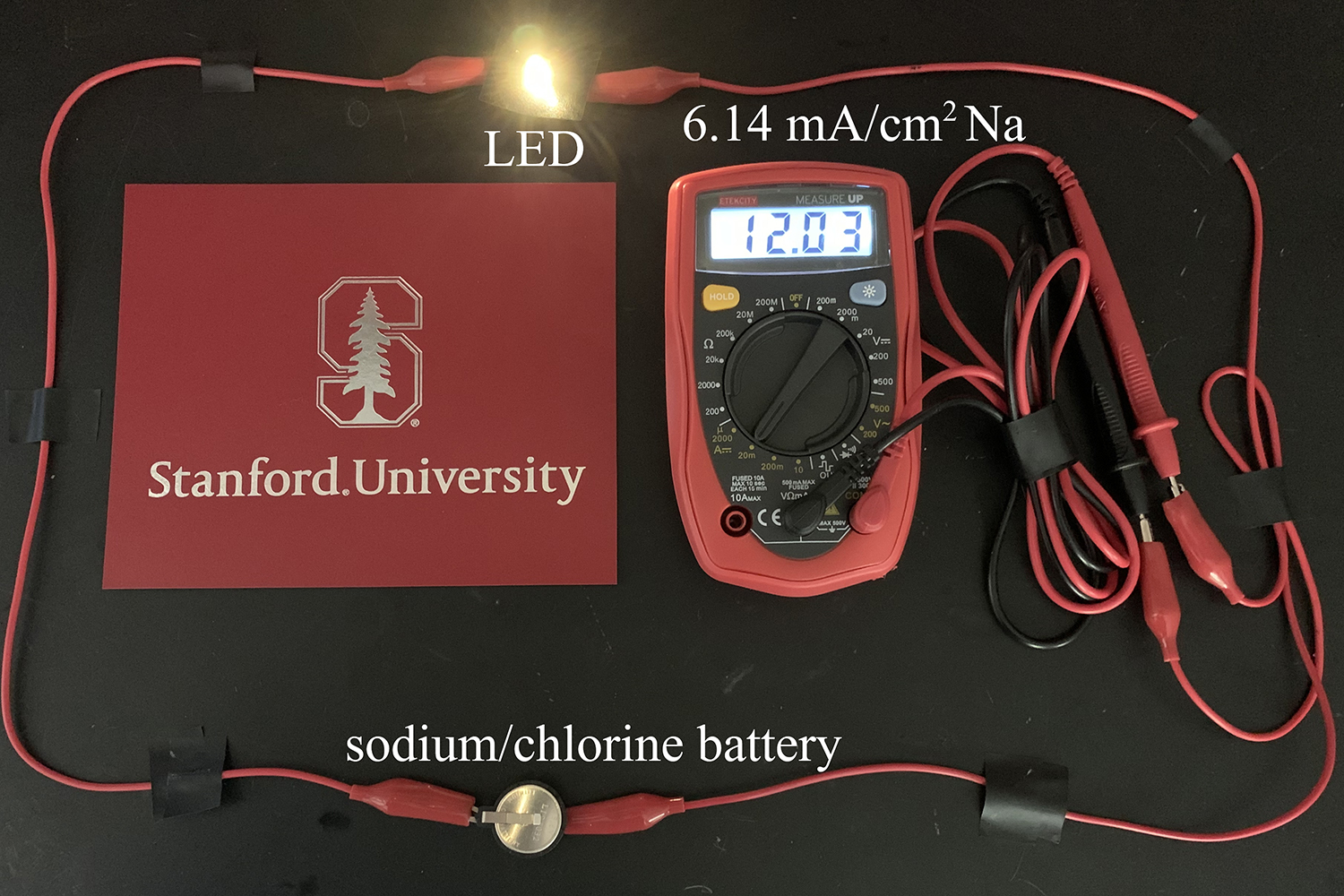
Figure Description: An LED light is powered by a prototype rechargeable battery using the sodium-chlorine chemistry developed recently by Stanford researchers. (Image credit: Guanzhou Zhu)
Stage of Research
Applications
- Grid storage
- Electric vehicles
- Personal electronics
- Utility metering or GPS tracking
Advantages
- High capacity/energy density
- Na/Cl battery: >100 cycles up to 1000mAh/g with an average ~3.55 V discharge plateau
- Li/Cl battery: reversible cyclability at capacity up to 800 mAh/g with an average ~ 3.6 V discharge plateau
- Rechargeable
- Cheaper sodium design
Publications
- Zhu, G., Tian, X., Tai, HC. et al. Nature 596, 525–530 (2021). "Rechargeable Na/Cl2 and Li/Cl2 batteries".
- Myers, Andrew. Stanford News (2021) Stanford researchers make rechargeable batteries that store six times more charge
- Dai et al. Research Square (2020) "A Rechargeable Na/Cl Battery"
Related Links
Patents
- Published Application: WO2022067110
- Published Application: 20230369594
Similar Technologies
-
Nanoscale Interfacial Engineering with Interconnected Hollow Carbon Nanospheres for Stable Lithium Metal Anode S14-006Nanoscale Interfacial Engineering with Interconnected Hollow Carbon Nanospheres for Stable Lithium Metal Anode
-
Non-flammable polymeric electrolyte with wide operational temperature range S21-170Non-flammable polymeric electrolyte with wide operational temperature range
-
Thermoresponsive Material to Prevent Battery Fire S15-458Thermoresponsive Material to Prevent Battery Fire