Docket #: S24-243
Segmented Projection Optical Architecture for Large-area, High-resolution Vat Photopolymerization
Stanford researchers have developed an innovative optical architecture that enables projection-based vat photopolymerization (VP) 3D printers to significantly expand the printable area without sacrificing resolution, speed, or structural integrity.
In most projection-based systems, the printable area is limited by the optical field of view of the projector. Expanding the build area typically requires mechanically moving the projector or build platform, or combining multiple synchronized projectors. These solutions increase system complexity, introduce alignment challenges, and often slow the printing process.
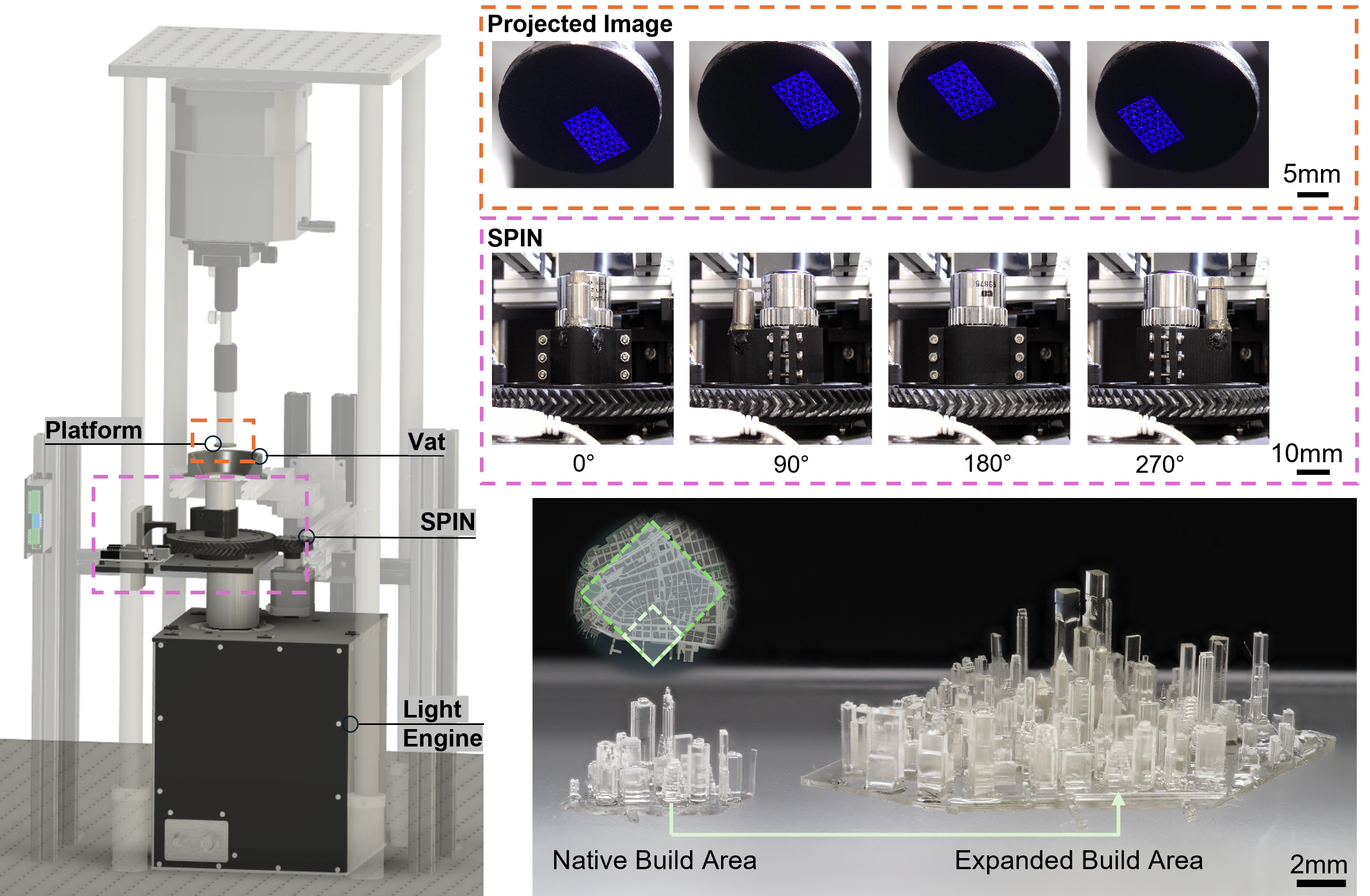
This technology addresses these limitations through a method called Segmented Projection Image Translation (SPIN). Instead of moving the light engine, the system slightly shifts the projection objective laterally relative to the optical axis using principles similar to tilt-shift optics. This controlled shift displaces the projected image across the build surface. During printing, the system sequentially projects multiple image segments that together cover a larger fabrication area while preserving the native pixel resolution of the projector. The result is a substantially expanded printable area while maintaining fine feature fidelity.
Because the approach relies primarily on simple optical modifications and software-controlled segmentation, it can potentially be incorporated into existing projection-based 3D printing platforms. The technology provides a practical path toward scaling high-resolution vat photopolymerization for industrial manufacturing and advanced microfabrication.
Stage of Development
Prototype
Figure
Applications
- Large-area, high-resolution projection-based 3D printing
- Microfabrication of microfluidic devices and microsystems
- Manufacturing of high-surface-area battery and energy materials
- Biomedical scaffolds and tissue engineering structures
Advantages
- Expands build area without reducing resolution
- Avoids complex multi-projector systems
- Reduces alignment errors and stitching artifacts
- Compatible with existing projection-based 3D printers
Related Links
Similar Technologies
-
Denoising WaveY-Net: An ultra-fast, auxiliary neural network enhanced surrogate field solver S22-445Denoising WaveY-Net: An ultra-fast, auxiliary neural network enhanced surrogate field solver
-
Fully elastic dielectric polymer for photolithography of flexible electronics S17-306Fully elastic dielectric polymer for photolithography of flexible electronics
-
High-density, direct photo-patterning of stretchable electronic polymers S19-138High-density, direct photo-patterning of stretchable electronic polymers