Docket #: S21-119
Augmenting High-dimensional Nonlinear Optimization with Conditional GANs
Stanford researchers have developed a method to use conditional generative adversarial networks (C-GANs) for solving highly complex optimization problems, e.g., with 1050 to 10 80 dimensions. The C-GAN learns the underlying distribution of solutions found by an optimization algorithm, then generates further optimized solutions. Adversarial training enables the C-GAN model to learn the distribution of solutions and to generate more optimized solutions in a shorter time than that needed to run the original optimization algorithm. This regression-based method yields solutions with desired labels rather than a random set of optimization solutions. This method is specifically effective in augmenting heuristic optimization algorithms, which get stuck at local solutions, for solving high-dimensional and complex mathematical optimizations.
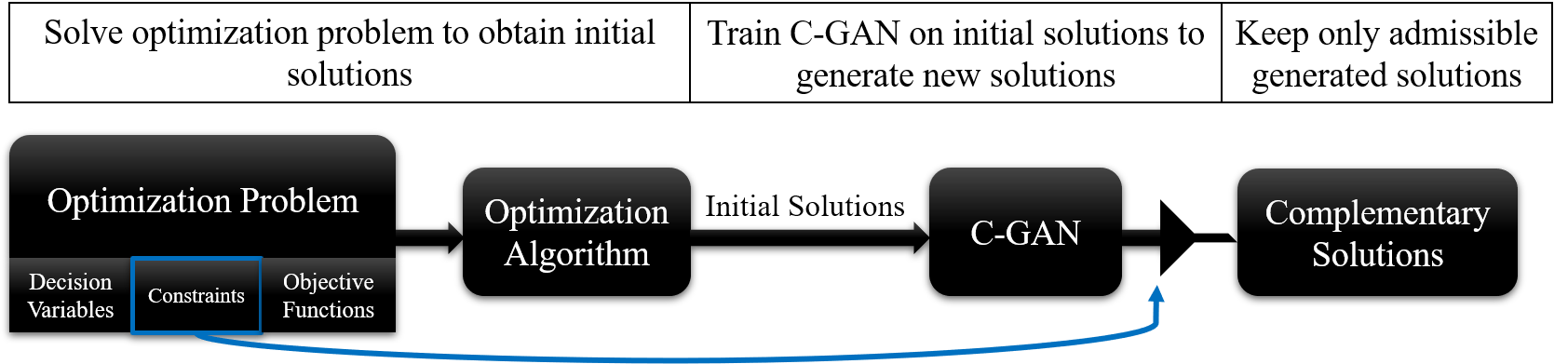
Photo description: Overview of the proposed algorithm for using a C-GAN to complement an optimization algorithm on a high-dimensional nonlinear optimization. Credit: Kalehbasti et al. arXiv (2021)
Stage of Research
Applications
- Improve optimization for high-dimensional and complex problems
- Multivariate multiple regression
- Mathematical optimization
Advantages
- Trains on results of classic optimization methods and generates more optimized solutions
- Due to adversarial training, has much shorter runtime than classic optimization algorithms
Publications
- Kalehbasti et al. arXiv (2021) Augmenting High-dimensional Nonlinear Optimization with Conditional GANs
- Kalehbasti et al. GECCO (2021) Augmenting High-dimensional Nonlinear Optimization with Conditional GANs
Similar Technologies
-
Enhancing Cryogenic Electro-Optic and Piezo-Electric Performance by Tuning Quantum Criticality S25-260Enhancing Cryogenic Electro-Optic and Piezo-Electric Performance by Tuning Quantum Criticality
-
Geosecurity System – Geotags from Multiple Sources and Noisy Location Data S08-349Geosecurity System – Geotags from Multiple Sources and Noisy Location Data
-
Self-Configuring Optical Networks for Continuous-Variable Quantum Information Processing S25-076Self-Configuring Optical Networks for Continuous-Variable Quantum Information Processing