Docket #: S21-024
Beyond Insulin: Cathelicidin Mediated IAPP Amyloid Prevention for Type 2 Diabetes and Pancreatic Dysfunction
Researchers from Stanford University and the Technical University of Munich (TUM) propose a new approach for treating Type 2 Diabetes (T2D) by targeting the cathelicidin gene expression pathway. Unlike conventional treatments that primarily manage blood glucose levels, this approach targets a fundamental pathological mechanism, islet amyloid polypeptide (IAPP or amylin) amyloid formation, that contributes to pancreatic inflammation, ?-cell degeneration, and overall disease progression. This represents a potential shift from symptom management to addressing a potential cause.
The treatment approach is based on studies of the Kapurniotu Lab at Technical University of Munich in collaboration with Barron's Lab at Stanford which reported that the antimicrobial and immunomodulatory polypeptide human cathelicidin LL-37 binds to IAPP with nanomolar affinity, suppressing IAPP amyloid self-assembly and related pancreatic ?-cell damage in vitro (Armiento et al. Angewandte Chemie (2020)). The results supported the suggestion that the 37-residue LL-37 may play a protective role in T2D pathogenesis and provided a molecular basis for designing LL-37-derived peptides with combined antimicrobial, immunomodulatory, and anti-amyloid properties as potential multifunctional drug candidates (Armiento et al. Angewandte Chemie (2020)). The findings could be leveraged in pre-diabetic patients to prevent or delay T2D progression, and for personalized T2D treatment and direct monitoring of pancreatic islet function through quantitative imaging to establish individualized treatment targets, enabling a more personalized approach than standard glycemic control protocols.
Figure
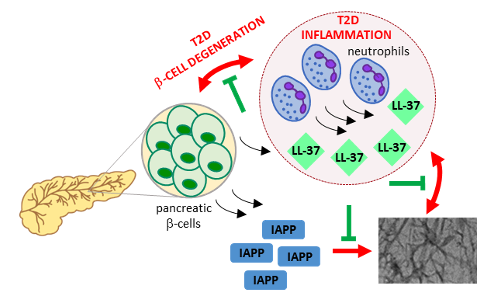
Figure Description: Suggested protective role of LL-37-IAPP interaction in pancreatic amyloid formation, inflammation, ?-cell degeneration, and T2D pathogenesis. (Image from: Armiento, V., et al. (2020))
Stage of Development
Proof of Concept
Applications
- Potentially: Type 2 diabetes (T2D) treatment, prevention, and monitoring beyond conventional insulin management
Advantages
- Disease modifying rather than symptom managing: LL-37 targets IAPP which could prevent a fundamental T2D pathological mechanism
- Could preserve the pancreatic cells responsible for insulin production and reduce pancreatic inflammation
- Potential for preventing or delaying progression to clinical T2D in pre-diabetic patients
- Potentially higher physiologic tolerance - leverages the body's own protective peptide systems
- Envisioned potential personalized treatment options:
- Direct monitoring of pancreatic islet function through quantitative, safe, in vivo imaging with individualized treatment targets
- L/B ratio monitoring (LL-37 to IAPP) could provide a biomarker framework for determining when intervention is needed and assessing treatment efficacy
Publications
- Armiento, V., Barron, A. E., Kapurniotu, A., & Fortkort, J. A. (2024). U.S. Patent Application No. 17/759,710.
- Armiento, V., Hille, K., Naltsas, D., Lin, J. S., Barron, A. E., & Kapurniotu, A. (2020). The human host-defense peptide cathelicidin LL-37 is a nanomolar inhibitor of amyloid self-assembly of islet amyloid polypeptide (IAPP). Angewandte Chemie International Edition, 59(31), 12837-12841. https://doi.org/10.1002/anie.202000148
Related Links
Patents
- Published Application: WO2021155025
- Published Application: 20240268768
- Issued: 12,685,490 (USA)
Similar Technologies
-
DART-Met: Dynamic AI-Driven Raman Techniques for Biomarker monitoring in Metabolic disorders S25-113DART-Met: Dynamic AI-Driven Raman Techniques for Biomarker monitoring in Metabolic disorders
-
Harnessing Cathelicidin Gene CAMP Upregulation as Adjuvant Therapy for Disease Treatment and Prevention S22-090Harnessing Cathelicidin Gene CAMP Upregulation as Adjuvant Therapy for Disease Treatment and Prevention
-
CD38-Directed Immune Conditioning for Type 1 Diabetes S26-116CD38-Directed Immune Conditioning for Type 1 Diabetes