Docket #: S20-348
Electrodialysis and electrochemical nitrate reduction process
Stanford researchers have developed an Electrodialysis and Nitrate Reduction Process (EDNR) that produces high-purity ammonia from agricultural runoff. EDNR uses electrochemical bias switching for ion transport and nitrate reduction, and an electrochemical membrane reactor with electrocatalysts capable of oxygen evolution and nitrate reduction to concentrate nitrate and ammonia, reduce nitrate to ammonia, and recover alkaline ammonia from various wastewaters.
This two-step process of electrodialysis and nitrate reduction successfully concentrated ammonia about 12 times compared to the nitrate and ammonia in original wastewater. When powered by renewable electricity, EDNR provides sustainable water treatment and fertilizer production, especially for areas not served by conventional manufacturing. This technology is part of portfolio of related inventions (S19-331, S20-348, S20-349, S23-336) that extract value from wastewater by reclaiming ammonia from nitrate-contaminated wastewater streams.
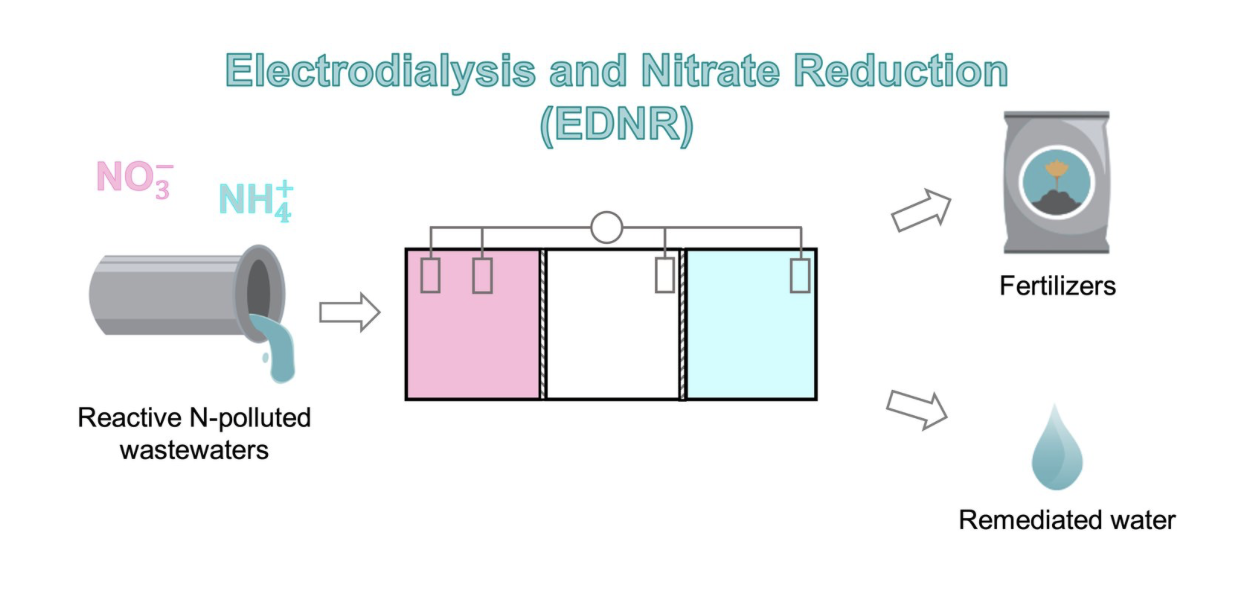
Electrodialysis and Nitrate Reduction(EDNR) of Wastewater
(Image courtesy the Tarpeh Lab)
Stage of Development – Proof of Concept
Applications
- Wastewater treatment and environmental protection
- Industrial ammonia recovery and resource recycling
- (Decentralized) ammonia production - fertilizers, disinfectant alkaline ammonia, and ammonia gas
Advantages
- Portable and Scalable - EDNR runs on a portable, modular device that requires only electricity, it can be used in smaller, decentralized settings (including space) or scaled up for industry
- Enhanced Efficiency and Consistency – Proof of concept device successfully concentrated ammonia about 12 times compared to the nitrate and ammonia in the original wastewater
- Versatile - EDNR cell selectively recovers ammonia from multiple types of nitrogenous compounds (nitrate, nitrite, and ammonium)
- Three chamber setup avoids the need for activated carbon
Publications
- Guo, J., Liu, M. J., Laguna, C., Miller, D. M., Williams, K. S., Clark, B. D., B.D., Muñoz, C., Blair, S.J., Nielander, A.C., Jaramillo, T.F., & Tarpeh, W. A. (2024). Electrodialysis and nitrate reduction (EDNR) to enable distributed ammonia manufacturing from wastewaters. Energy & Environmental Science, 17(22), 8787-8800. DOI: 10.1039/D4EE03002H
- Tarpeh, W. A., Liu, M. J., & Clark, B. D. (2023). U.S. Patent Application No. 18/041,769.
- Roberts, T. (2024). William Tarpeh taps the potential of polluted water. Stanford News. https://news.stanford.edu/stories/2024/10/william-tarpeh-creativity-leads-innovative-wastewater-transformations
- Tarpeh, W. A., Senesky, D. G., Lalwani, A. V., Holliday, M., Mu, L., Clark, B. D., Liu, M.J., Dong, H., & Guo, J. (2022). U.S. Patent Application No. 17/642,902.
- Tarpeh, W. A., Kogler, A., Clark, B. D., Liu, M. J., & Chow, W. (2024). U.S. Patent Application No. 18/041,678.
- Miller, D. M., Liu, M. J., Abels, K., Kogler, A., Williams, K. S., & Tarpeh, W. A. (2024). Engineering a molecular electrocatalytic system for energy-efficient ammonia production from wastewater nitrate. Energy & Environmental Science, 17(15), 5691-5705. DOI: 10.1039/D4EE01727G
Related Links
Patents
- Published Application: WO2022040051
- Published Application: 20230365444
- Issued: 12,703,650 (USA)
Similar Technologies
-
Flexible electrochemical stripping to recover alkaline and acidic ammonia from wastewaters S20-349Flexible electrochemical stripping to recover alkaline and acidic ammonia from wastewaters
-
Electrochemical reactor for ammonia reclamation from wastewater nitrate S23-336Electrochemical reactor for ammonia reclamation from wastewater nitrate
-
Durable and Immersible Network Enabled Ammonia Sensor for Water Monitoring S19-331Durable and Immersible Network Enabled Ammonia Sensor for Water Monitoring