Docket #: S20-247
Quantitative Parkinson's Disease Rigidity Measurement System
The absence of a remote, reliable measure of rigidity, bradykinesia and tremor is a major limitation for telemedicine and multicenter clinical trials in Parkinson's disease (PD). Addressing this need, Stanford researchers have invented a device and process for simple, quantitative, and remote evaluation of rigidity, bradykinesia and tremor through the analysis of presses and releases of adjacent tensioned engineered levers that measure amplitude with submillimeter accuracy and timing of lever displacement, Figure 1. Repetitive alternating pressing and releasing with the index and middle fingers on this engineered, Bluetooth connected digitography device enables a remote, reliable and objective assessment of cardinal motor signs in PD.
Figure
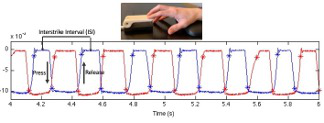
Figure 1 - Upper panel: photo of a digitography device with the index and middle fingers placed on the levers. Lower panel: example of alternating full amplitude presses and releases by the adjacent fingers over time. Each finger is denoted by red or blue trace respectively. The press and release phases are labelled with arrows. The y-axis is amplitude; the x-axis is time. The interstrike insterval (ISI) is the time it takes to complete a full cycle of the task with one finger.
Image Credit: H Bronte-Stewart presentation; photo from stock
Stage of Development
Applications
- Telemedicine – enables remote PD evaluation
- Multi-center clinical trials
Advantages
- Reliable, quantitative, and objective measures of rigidity, bradykinesia, tremor, freezing behavior
- Submillimeter accuracy
- Generates rigidity, bradykinesia, and tremor sub-scores in accordance with MDS- UPDRS III
- Enables remote PD evaluation
- Uses newly invented engineered digitography device which can measure amplitude/force metric over time
- This engineered keyboard is Bluetooth enabled
- First demonstration of this method of quantitative measure of rigidity
Publications
- Trager, Megan H., Kevin B. Wilkins, Mandy Miller Koop, and Helen Bronte-Stewart. "A validated measure of rigidity in Parkinson's disease using alternating finger tapping on an engineered keyboard." Parkinsonism & related disorders 81 (2020): 161-164.
- Trager, Megan H., Anca Velisar, Mandy Miller Koop, Lauren Shreve, Emma Quinn, and Helen Bronte-Stewart. "Arrhythmokinesis is evident during unimanual not bimanual finger tapping in Parkinson's disease." Journal of clinical movement disorders 2, no. 1 (2015): 1-7.
- Wilkins KB, Petrucci MN, Kehnemouyi Y, Velisar A, Han K, Orthlieb G, Trager MH, O'Day JJ, Aditham S, Bronte-Stewart H. Quantitative Digitography Measures Motor Symptoms and Disease Progression in Parkinson's Disease J Parkinsons Dis. 2022 Jun 7. doi: 10.3233/JPD-223264. PMID: 35694934.
Related Links
Patents
- Published Application: WO2022026765
- Published Application: 20240008798
- Issued: 12,740,740 (USA)
Similar Technologies
-
Method and apparatus for autonomous parameter adaptation of non-invasive multichannel stimulation S23-409Method and apparatus for autonomous parameter adaptation of non-invasive multichannel stimulation
-
Device and method for effective multi-modal sensory neuromodulation S25-189Device and method for effective multi-modal sensory neuromodulation
-
A Label-Free alpha-Synuclein Aggregate Detection Assay S23-240A Label-Free alpha-Synuclein Aggregate Detection Assay