Docket #: S26-075
Ultra-Low-Cost Carbon Nanotubes for Stronger Cement and Cost-Competitive Clean Hydrogen
Stanford researchers have developed a catalytic process that co-produces low-carbon hydrogen and carbon nanotubes (CNTs) inexpensively enough to add to ordinary cement without raising its price.
Steam methane reforming produces about 95% of U.S. and 75% of global hydrogen, emitting roughly 9 kg of CO2 per kilogram. Methane pyrolysis cuts emissions by producing solid carbon, but uses twice the natural gas and, without carbon pricing, is viable only if that carbon can be sold. However, existing carbon markets are too small, and the entire carbon black market would offset only about 5% of reformer-based hydrogen.
The Stanford catalytic co-production method makes CNTs several orders of magnitude cheaper than those available today, turning the global cement market, more than 4 Gt per year, into a practical outlet for pyrolysis carbon. Revenue from the CNTs offsets the added feedstock cost, positioning low-carbon hydrogen to compete with steam reforming. In laboratory tests, cement paste containing the CNTs showed about 22% higher compressive strength and 53% higher tensile strength than an ordinary Portland cement control.
The result is a single process that tackles both the market and technical barriers that have kept methane pyrolysis from scaling.
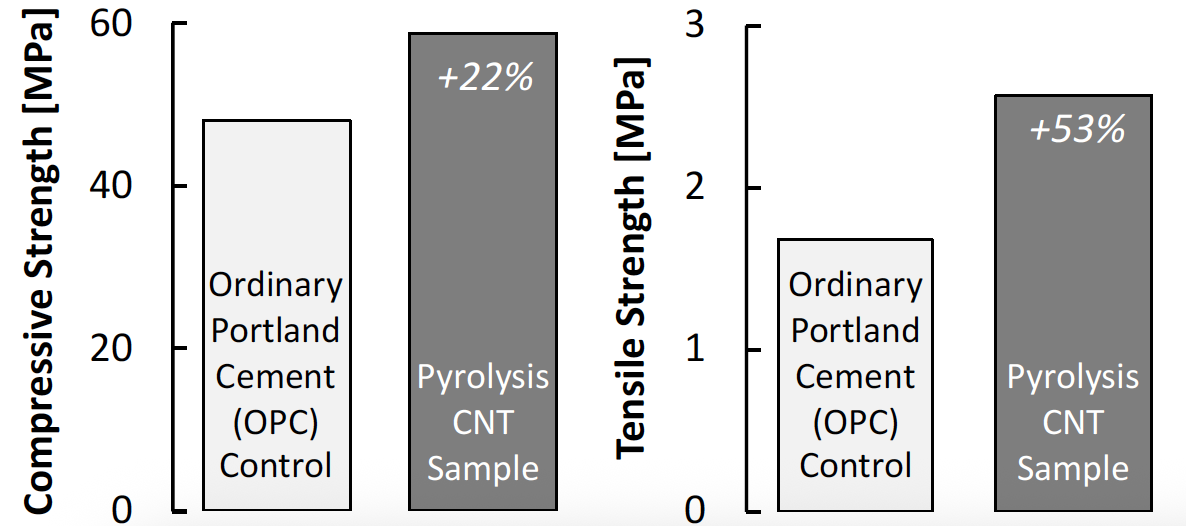
Material Enhancement with CNTs: Compressive (+22%) and tensile (+53%) strength of cement paste containing pyrolysis CNTs versus an ordinary Portland cement control.
(Images courtesy the Cargnello Group and Rock Physics and Geomaterials Lab)
Stage of Development:Proof of concept
CNT and hydrogen co-production has been demonstrated in a bench-scale reactor, and cement paste samples tested after a 28-day cure show strength gains.
Applications
- Low-carbon hydrogen for refining, fertilizer, and other industrial uses
- Strength-enhancing additives for concrete and other cementitious materials
- Non-corrosive reinforcement for thin slabs, complex geometries, seawater-hydrated mixes, and 3D-printed structures
- Low-cost CNTs for polymers and other building materials
Advantages
- CNT production several orders of magnitude cheaper than those from conventional processes
- Projected hydrogen cost below $1/kg, beating steam reforming at natural gas prices under $4/MMBtu
- Roughly 3x lower CO2 emissions than steam reforming
- About 22% higher compressive and 53% higher tensile strength in cement paste lab tests
- Non-corrosive, avoiding the corrosion issues of steel rebar
- Compatible with conventional steam-reformer infrastructure, with no special cement mixing required
Related Links
Similar Technologies
-
Engineered Biopolymer Composite: A near structural-grade, carbon-negative cement alternative S25-133Engineered Biopolymer Composite: A near structural-grade, carbon-negative cement alternative
-
Lignin biopolymer-bound soil composite (BSC): a sustainable, recyclable, carbon-negative, construction material S23-551Lignin biopolymer-bound soil composite (BSC): a sustainable, recyclable, carbon-negative, construction material
-
Materials for low cost, scalable, thermochemical hydrogen production S16-325Materials for low cost, scalable, thermochemical hydrogen production