Docket #: S18-035
Low-cost, durable anode to split seawater for efficient renewable energy storage
Summary: Research in Prof. Hongjie Dai's laboratory have developed a robust anode that directly converts alkaline seawater to hydrogen fuel at large current densities for at least 1000 hours without corrosion or performance decay.
Background/Problem: Generating hydrogen from water is a promising approach for storing intermittent renewable energy (e.g., solar or wind power). However, current technologies for electrolysis to split water into hydrogen and oxygen require purified water. Therefore, grid-scale electrolysis would put heavy strain on vital water resources. Electrodes (particularly anodes) that can sustain seawater splitting without corrosion could address the water scarcity issue.
Solution: This highly active, corrosion-resistant anode has a unique bi-layer structure that results in long-term stability. The anode is 100% selective for the oxygen evolution reaction (OER), without Cl2 evolution. In addition, it is fabricated from low-cost, abundant materials. These features enable direct electrolysis on seawater (without costly desalination) at current densities and temperatures that are used in industrial water electrolysis.
Results and Related Technology: This anode/oxygen evolution catalyst can be paired with a cathode developed by the Dai lab (Stanford Docket S18-041, a low-cost hydrogen evolution electrocatalyst). Using these technologies together, the inventors have achieved a high electrolysis current density of 400 mA/cm2 for stable alkaline seawater splitting without decay for over 1000 hours under an applied voltage of only 1.72V without anode corrosion or activity loss.
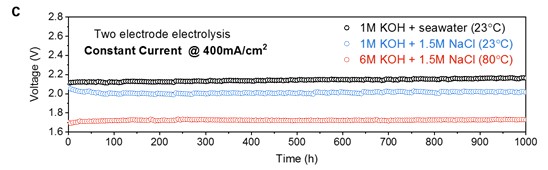
Sustained, energy efficient seawater splitting continuously over 1000 hours. Durability test for electrolysis in an alkaline seawater electrolyte (black), an alkaline simulated seawater electrolyte with near saturated salt concentration (blue) and industrial electrolysis conditions (red).
Applications
- Renewable energy storage/hydrogen production for fuel cells
- Oxygen production including diving equipment to reduce need for oxygen tanks
Advantages
- Long-lasting and durable:
- highly active anode maintains performance throughout 1000h stability test
- corrosion-resistant in alkaline seawater
- Direct electrolysis - splits seawater into H2 and O2 without forming chlorine gas
- anode is 100% selective for oxygen evolution reaction without Cl2 evolution
- no costly desalination step to remove chlorine ions
- active in seawater with a wide range of NaCl concentrations (0.5 to 2 M) and operating temperatures (23 to 80 degrees Centigrade)
- Low-cost:
- catalyst fabricated from Earth-abundant materials
- simple to assemble
- Low operating voltage - the voltage required to reach 400 mA/cm2 matches industrial electrolyzers that use purified water
Related Links
Patents
- Published Application: WO2019160701
- Published Application: 20210002777
- Issued: 11,326,265 (USA)
Similar Technologies
-
High efficiency electrocatalysis with lung-inspired architecture S17-342High efficiency electrocatalysis with lung-inspired architecture
-
Oxygen tolerant hydrogenases by mutating electron supply pathway S15-300Oxygen tolerant hydrogenases by mutating electron supply pathway
-
Flow Batteries with High Energy Density Redox-active eutectic liquid S18-551Flow Batteries with High Energy Density Redox-active eutectic liquid